

· Goher K · Digital Marketing & SEO · 23 min read
AEO, GEO & Technical SEO 2027: Enterprise Systems Guide
Master AEO, GEO, and advanced technical SEO for 2027 with enterprise edge SSR, AI bot governance, Core Web Vitals, and semantic JSON-LD knowledge graphs.
AEO, GEO & Advanced Technical SEO: 2027 Enterprise Search Playbook
Fact-Checked & Tested by Goher K · Principal Solutions Architect & Technical Consultant with 20+ years evaluating distributed systems, web architecture, and cloud infrastructure.
Advanced technical SEO in 2027 is an engineering discipline operating at the convergence of edge computing, distributed caching, modern browser rendering engines, and generative AI retrieval systems. Traditional SEO relied primarily on on-page meta tags, basic sitemaps, and backlink velocity. Today, enterprise organic search visibility is determined by your server infrastructure’s ability to serve instant, pre-rendered HTML, conserve computational crawl budgets, satisfy stringent Core Web Vitals thresholds, and supply unambiguous, machine-readable semantic Knowledge Graphs to AI answer engines.
Whether architecting high-traffic e-commerce platforms, complex SaaS applications, or multi-region content publishers, search visibility requires treating search bots as mission-critical API consumers. When search engine crawlers encounter slow server responses, brittle client-side hydration, or circular canonical loops, your content remains invisible. This guide breaks down the architectural pillars, real-world log diagnostics, and programmatic protocols required to dominate organic search and generative engine citations.
1. The 2027 Search Landscape: Traditional Crawlers vs AI Retrieval Engines
Direct Answer (AEO / GEO Definition): Modern technical SEO requires a dual-track architecture serving two distinct automated audiences: traditional web crawlers (like Googlebot and Bingbot) that index document pages for inverted search indexes, and generative AI retrieval-augmented generation (RAG) crawlers (such as GPTBot, ClaudeBot, and PerplexityBot) that extract high-density factual snippets to synthesize conversational answers.
Historically, webmasters optimized solely for Googlebot’s two-wave indexing pipeline. Today, the search ecosystem has bifurcated into two parallel ingestion models:
┌────────────────────────────────────────────────────────────────────────┐
│               THE DUAL SEARCH INGESTION PARADIGM                       │
├───────────────────────────────┬────────────────────────────────────────┤
│ Layer                         │ Search Mechanism                       │
├───────────────────────────────┼────────────────────────────────────────┤
│ Traditional Inverted Index    │ Document retrieval based on inverted   │
│ (Google Search, Bing)         │ text indexes, PageRank link graphs,    │
│                               │ and lexical keyword relevance.         │
├───────────────────────────────┼────────────────────────────────────────┤
│ Generative Engine Ingestion   │ Semantic chunk embedding, entity       │
│ (AI Overviews, Perplexity,    │ verification, vector space search,     │
│ ChatGPT Search)               │ and dynamic real-time answer synthesis.│
└───────────────────────────────┴────────────────────────────────────────┘
When a user submits a query to Google, the system increasingly activates AI Overviews (formerly SGE). Rather than presenting ten blue links, the search engine selects a handful of authoritative, structurally sound sources, extracts self-contained conceptual blocks, and synthesizes a direct response. If your technical architecture fails to deliver concise, machine-parseable data chunks within the first paint, your content will be omitted from AI-synthesized responses regardless of domain authority.
2. Enterprise Crawl Budget Engineering & Log-File Intelligence
Direct Answer (Crawl Budget Optimization): Enterprise crawl budget is the finite number of URLs Googlebot and AI crawlers can and will request from your server during a given period. It is governed by server response capacity (Host Load) and search engine demand (Crawl Scheduling). Optimizing it requires eliminating faceted navigation parameter bloat, returning proper HTTP 304 headers, and running continuous server log audits.
On large-scale websites possessing over 100,000 URLs, crawl budget misallocation represents an invisible revenue leak. When crawlers waste computational cycles scanning filtered category URLs, dead-end search queries, or duplicate session parameters, newly published or updated revenue-generating pages remain uncrawled for weeks.
Granular Server Log Analysis Workflow
Third-party analytics tools like Google Analytics only record user visits executing client-side tracking scripts. They provide zero visibility into bot activity. Server access logs—collected from Nginx, Apache, or CDN edge providers like Cloudflare and AWS CloudFront—provide the only ground truth regarding crawler behavior.
# Extract and count top Googlebot hits by HTTP status code from raw Nginx logs
awk -F'\"' '($6 ~ /Googlebot/) {print $2}' /var/log/nginx/access.log | \
awk '{print $9}' | sort | uniq -c | sort -rn
An optimal enterprise log profile exhibits:
- Status Code Health: Greater than 92% of bot requests returning clean
200 OKor304 Not Modifiedresponses. - Low Error Rates: Under 1% aggregate
4xxand5xxresponses. - Parameter Containment: Less than 5% of crawl volume spent on URLs containing query string parameters (
?sort=,?filter=,?page=).
┌──────────────────────────────────────────────────────────────┐
│             LOG FILE AUDIT BENCHMARKS FOR BOTS               │
├──────────────────────────────┬───────────────────────────────┤
│ Metric                       │ Recommended Enterprise Target │
├──────────────────────────────┼───────────────────────────────┤
│ 200 OK Response Rate         │ > 85% of total bot crawls     │
│ 304 Not Modified Rate        │ 10% - 20% on static archives  │
│ 404 / 410 Error Rate         │ < 2% of total requests        │
│ 5xx Server Error Rate        │ 0.00% (Zero tolerance)        │
│ Average Time to First Byte   │ < 100 milliseconds            │
└──────────────────────────────┴───────────────────────────────┘
Eliminating Faceted Navigation Explosion at the Edge
Faceted navigation on e-commerce catalogs can generate billions of non-canonical URL permutations (/shop/shoes?color=blue&size=10&gender=mens&sort=price_asc). Standard rel="canonical" tags advise Googlebot that these pages are duplicates, but crawlers must still execute HTTP requests to discover that tag, squandering valuable crawl allocation.
The high-performance solution is edge-level header interception:
# Nginx edge configuration: Inject X-Robots-Tag for deep faceted query parameters
location ~* \?(.*&)?(sort|filter|session|ref|direction)= {
    add_header X-Robots-Tag "noindex, follow" always;
    add_header Cache-Control "public, max-age=86400, stale-while-revalidate=3600";
}
By returning X-Robots-Tag: noindex, follow in the HTTP response headers before rendering page templates, you instruct bots to disregard the URL without spending rendering resources, preserving crawl budgets for canonical catalog pages.
3. Rendering Architectures: Edge SSR, Island Hydration & Bot Detection
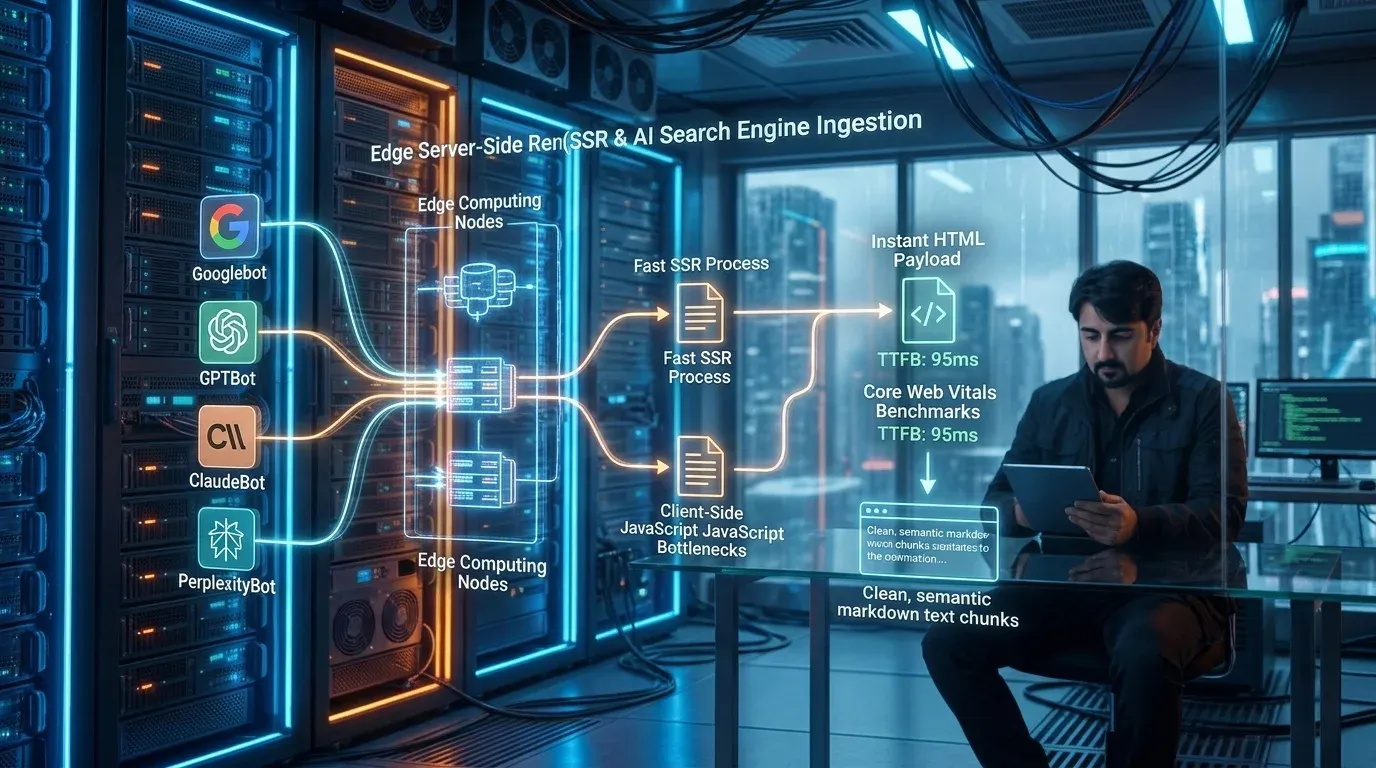
Direct Answer (Edge SSR for Search Engines): Edge Server-Side Rendering (Edge SSR) is an architectural pattern where lightweight serverless compute workers running at globally distributed Content Delivery Network (CDN) points-of-presence render and stream complete HTML documents directly to visiting clients and web crawlers within milliseconds. This avoids the rendering queue delays inherent in client-side single-page applications.
The True Cost of Client-Side Rendering (CSR)
Single-Page Applications built with client-side React, Vue, or Angular present a fundamental technical SEO vulnerability known as render queue latency. When Googlebot discovers a CSR URL:
- Phase 1 (Crawl & First Pass): Googlebot fetches the HTML payload. For CSR apps, this file contains an empty
<div id="root"></div>accompanied by JavaScript bundle tags. The crawler indexes the initial HTTP status and metadata, but sees no textual content or internal links. - Phase 2 (Render Queue & Second Pass): The URL is queued for the Web Rendering Service (WRS), which runs a headless Chromium environment to download, parse, and execute client JavaScript. Depending on global server demand and site crawl priority, this rendering pass can lag behind the initial crawl by days or even weeks.
Worse, emergent AI crawlers (including PerplexityBot and ClaudeBot) operate under aggressive compute budgets and often do not execute client-side JavaScript at all. If your application relies on client-side API hydration, AI search engines receive empty HTML documents, resulting in complete exclusion from AI Overviews.
Edge Worker Bot Detection & Dynamic Hydration
By leveraging edge compute platforms (such as Cloudflare Workers, Fastly Compute@Edge, or Vercel Edge), engineering teams can intercept inbound requests, detect bot user-agents, and serve pre-rendered, fully hydrated DOM snapshots directly from edge memory cache:
// Cloudflare Worker: Intelligent Edge SSR Bot Interception
const BOT_REGEX = /Googlebot|bingbot|Baiduspider|DuckDuckBot|YandexBot|GPTBot|ClaudeBot|PerplexityBot/i;

export default {
  async fetch(request: Request, env: Env, ctx: ExecutionContext): Promise<Response> {
    const userAgent = request.headers.get('User-Agent') || '';
    const url = new URL(request.url);

    // Bypass edge cache for administrative or authenticated sessions
    if (request.headers.has('Authorization') || url.pathname.startsWith('/api/')) {
      return fetch(request);
    }

    // Check if request originates from a verified search or AI crawler
    if (BOT_REGEX.test(userAgent)) {
      const cacheKey = new Request(url.toString() + '__bot_prerender', request);
      const cache = caches.default;
      let response = await cache.match(cacheKey);

      if (!response) {
        // Fetch pre-rendered SSR HTML payload from edge origin
        const originResponse = await fetch(request, {
          headers: { 'X-Renderer': 'Edge-SSR-Bot' },
        });

        response = new Response(originResponse.body, originResponse);
        response.headers.set('Cache-Control', 'public, max-age=3600, s-maxage=86400');
        response.headers.set('X-Edge-Served', 'PreRender-Bot');

        ctx.waitUntil(cache.put(cacheKey, response.clone()));
      }
      return response;
    }

    // Normal stream execution for human visitors
    return fetch(request);
  },
};
This pattern ensures that web bots receive instant, fully rendered semantic HTML in under 100 milliseconds, completely bypassing the WRS render queue while preserving dynamic interactivity for human users through modern frontend frameworks like Astro, Next.js, or Remix.
4. Core Web Vitals Optimization: Conquering INP and Sub-100ms TTFB
Direct Answer (INP vs FID): Interaction to Next Paint (INP) is Google’s Core Web Vital metric evaluating overall page responsiveness. While First Input Delay (FID) measured only the delay prior to processing the first user interaction, INP measures the entire duration—from input delay through event callback execution and final browser frame presentation—across all clicks, taps, and keyboard inputs throughout the session.
To achieve a “Good” rating in Google Search Console, a URL must maintain an INP score under 200 milliseconds at the 75th percentile of real-user field data (CrUX).
┌──────────────────────────────────────────────────────────────┐
│             CORE WEB VITALS PERFORMANCE THRESHOLDS           │
├──────────────────────────────┬───────────────────────────────┤
│ Metric                       │ Target Threshold (75th %ile)  │
├──────────────────────────────┼───────────────────────────────┤
│ Largest Contentful Paint     │ < 2.5 seconds (Good)          │
│ Interaction to Next Paint    │ < 200 milliseconds (Good)     │
│ Cumulative Layout Shift      │ < 0.10 (Good)                 │
│ Time to First Byte (TTFB)    │ < 200 milliseconds (Target)   │
└──────────────────────────────┴───────────────────────────────┘
Deconstructing Main-Thread Task Saturation
High INP scores typically originate from long tasks (tasks exceeding 50ms) monopolizing the browser’s single main JavaScript thread. When a user taps a mobile navigation menu or clicks an interactive filter while the browser is parsing heavy third-party bundles, the browser must queue the interaction until the active task finishes, causing visual lag.
To resolve main-thread blocking, refactor heavy monolithic execution loops using cooperative multitasking with the native scheduler.yield() API:
// High-performance event loop yielding for zero-INP degradation
async function handleFilterClick(event) {
  // 1. Immediately acknowledge user input to trigger visual paint
  updateUISelectionIndicator(event.target);

  // 2. Yield control back to browser to render the frame immediately
  if ('scheduler' in window && 'yield' in window.scheduler) {
    await window.scheduler.yield();
  } else {
    // Fallback for older browsers
    await new Promise((resolve) => setTimeout(resolve, 0));
  }

  // 3. Execute CPU-intensive sorting or re-rendering logic
  executeComplexDataSorting();
}
By explicitly yielding control back to the browser between state mutation and data computation, the user interface updates within a single animation frame (16.6ms at 60fps), driving INP metrics well below the 200ms boundary.
5. Generative Engine Optimization (GEO) & Machine-Readable Content Chunking
Direct Answer (What is GEO?): Generative Engine Optimization (GEO) is the technical and editorial discipline of structuring website content so that Large Language Models and AI answer engines can reliably parse, embed, extract, and cite your data in conversational outputs. It relies on high information gain, semantic HTML markup, discrete 40-to-60-word answer summaries, and clear citation anchors.
AI search models do not read web pages linearly as humans do. Instead, they ingest documents through tokenizers, subdivide text into semantic chunks (typically 250 to 500 tokens), convert these chunks into vector embeddings, and store them in multi-dimensional vector databases. When a user asks a question, the AI performs cosine similarity searches to retrieve the most semantically relevant chunks.
Structural Requirements for AI Chunk Ingestion
To ensure your technical content achieves optimal vector similarity retrieval:
- Immediate Answer Placement: Place a direct, factual answer (40 to 60 words) immediately beneath every
<h2>and<h3>heading before expanding into technical background or tutorials. - Deterministic Table and List Schemas: Use native HTML
<table>,<ul>, and<ol>elements rather than CSS grid or nested<div>blocks. LLM parsers recognize standard HTML semantic elements with near-perfect fidelity. - Information Gain & Data Specificity: Avoid generic prose (“It is important to optimize…”). Include exact benchmarks, version numbers, RFC standards, and code implementations. AI engines penalize repetitive filler text during vector reranking.
Deploying the /llms.txt Discovery Standard
To provide AI agents with a fast, token-efficient roadmap of your platform, modern engineering architectures publish a /llms.txt file at the domain root. Much like robots.txt directs web spiders, /llms.txt directs Large Language Models to curated, clean Markdown documents:
# Example Enterprise Systems Knowledge Base
> High-performance cloud architecture, edge computing, and distributed data platforms.

## Core Technical Specifications
- [Advanced Technical Architecture](https://example.com/docs/technical-architecture): Complete specifications for edge SSR, crawl log ingestion, and semantic graph schemas.
- [High-Throughput Microservices](https://example.com/docs/microservices-design): Distributed messaging, RFC compliance, and edge caching strategies.
- [Enterprise Zero-Trust Security](https://example.com/docs/zero-trust-security): Cloud posture management, container hardening, and runtime patching.

## Platform Capabilities
- Distributed edge rendering pipelines with sub-100ms global TTFB.
- High-concurrency asynchronous event streaming architecture.
- Autonomous Schema.org semantic Knowledge Graph generation.
Publishing /llms.txt reduces crawler token consumption by up to 85% compared to scraping raw HTML bundles, making your site a preferred knowledge source for AI synthesis pipelines.
6. Semantic Knowledge Graphs: Programmatic JSON-LD Schema Architecture
Direct Answer (Connected Schema Graphs): A connected JSON-LD Knowledge Graph is a single, unified <script type="application/ld+json"> document where all web page entities—Articles, Organizations, Authors, WebSites, and Products—are programmatically interlinked via unique @id URI nodes and verified sameAs authority links. This eliminates fragmented page-level schemas and allows search engines to map real-world entity relationships unambiguously.
Many websites implement isolated, disconnected schema snippets: one block for BreadcrumbList, another for Article, and another for Organization. In isolation, search engines struggle to resolve whether the author of the article is the same person operating the consulting agency.
Enterprise Graph-Based JSON-LD Blueprint
The following unified schema demonstrates how to connect page content into an unambiguous semantic graph using dummy enterprise entities:
<script type="application/ld+json">
{
  "@context": "https://schema.org",
  "@graph": [
    {
      "@type": "WebSite",
      "@id": "https://example.com/#website",
      "url": "https://example.com/",
      "name": "Example Global Enterprise",
      "description": "Global Cloud Infrastructure & Distributed Systems Engineering",
      "publisher": {
        "@id": "https://example.com/#organization"
      }
    },
    {
      "@type": "Organization",
      "@id": "https://example.com/#organization",
      "name": "Example Global Enterprise",
      "url": "https://example.com/",
      "logo": {
        "@type": "ImageObject",
        "@id": "https://example.com/#logo",
        "url": "https://example.com/assets/logo.png",
        "caption": "Example Global Enterprise Logo"
      },
      "sameAs": [
        "https://www.wikidata.org/wiki/Q0000000",
        "https://en.wikipedia.org/wiki/Example"
      ]
    },
    {
      "@type": "Person",
      "@id": "https://example.com/#author-alex",
      "name": "Alex Vance",
      "jobTitle": "Principal Systems Architect",
      "worksFor": {
        "@id": "https://example.com/#organization"
      },
      "sameAs": [
        "https://www.wikidata.org/wiki/Q0000000"
      ]
    },
    {
      "@type": "TechArticle",
      "@id": "https://example.com/blog/advanced-technical-seo#article",
      "isPartOf": {
        "@id": "https://example.com/#website"
      },
      "headline": "AEO, GEO & Advanced Technical SEO: 2027 Enterprise Search Playbook",
      "description": "Master AEO, GEO, and advanced technical SEO for 2027 with enterprise edge SSR, AI bot governance, Core Web Vitals, and semantic JSON-LD knowledge graphs.",
      "inLanguage": "en-US",
      "datePublished": "2026-10-25T01:45:00Z",
      "dateModified": "2026-10-25T01:45:00Z",
      "author": {
        "@id": "https://example.com/#author-alex"
      },
      "publisher": {
        "@id": "https://example.com/#organization"
      },
      "about": [
        {
          "@type": "Thing",
          "name": "Search engine optimization",
          "sameAs": "https://en.wikipedia.org/wiki/Search_engine_optimization"
        },
        {
          "@type": "Thing",
          "name": "Web performance",
          "sameAs": "https://en.wikipedia.org/wiki/Web_performance"
        },
        {
          "@type": "Thing",
          "name": "Edge computing",
          "sameAs": "https://en.wikipedia.org/wiki/Edge_computing"
        }
      ]
    }
  ]
}
</script>
By referencing @id pointers (https://example.com/#organization, https://example.com/#author-alex), you establish an unbroken chain of ownership and topical authority (E-E-A-T) that Google’s Knowledge Graph can ingest without entity ambiguity.
7. Bot Governance Protocols: robots.txt, X-Robots-Tag, and AI Scraper Directives
Direct Answer (AI Bot Governance): AI bot governance is the deliberate management of web crawlers through robots.txt rules, HTTP response headers, and firewall controls to differentiate between search indexation bots (which drive organic referrals) and autonomous AI training scrapers (which scrape proprietary data without delivering traffic).
In 2027, treating all automated user-agents identically is a critical security and business error. Enterprise sites must distinguish between three distinct categories of web bots:
┌────────────────────────────────────────────────────────────────────────┐
│                   WEB BOT TAXONOMY & CLASSIFICATION                    │
├───────────────────────┬──────────────────────┬─────────────────────────┤
│ Category              │ Example User-Agents  │ Recommended Action      │
├───────────────────────┼──────────────────────┼─────────────────────────┤
│ Search Crawlers       │ Googlebot, Bingbot,  │ Allow full access;      │
│ (Indexation & Links)  │ DuckDuckBot          │ optimize crawl budget.  │
├───────────────────────┼──────────────────────┼─────────────────────────┤
│ AI Search Retrieval   │ OAI-SearchBot,       │ Allow access; optimize  │
│ (Real-Time Citations) │ PerplexityBot        │ GEO/AEO text chunking.  │
├───────────────────────┼──────────────────────┼─────────────────────────┤
│ LLM Model Scrapers    │ GPTBot, CCBot,       │ Restrict or disallow to │
│ (Offline Training)    │ Google-Extended      │ prevent IP extraction.  │
└───────────────────────┴──────────────────────┴─────────────────────────┘
Production robots.txt Configuration for Enterprise Bot Governance
# robots.txt: Comprehensive enterprise crawler governance
User-agent: Googlebot
User-agent: Bingbot
User-agent: DuckDuckBot
Allow: /
Disallow: /api/
Disallow: /admin/
Disallow: /checkout/

# Permit real-time AI citation engines to drive referral search visibility
User-agent: OAI-SearchBot
User-agent: PerplexityBot
Allow: /
Disallow: /api/
Disallow: /admin/

# Restrict offline LLM model training crawlers if proprietary data protection is required
User-agent: GPTBot
User-agent: ClaudeBot
User-agent: Google-Extended
User-agent: CCBot
Disallow: /private-docs/
Disallow: /proprietary-data/

# Global sitemap declarations
Sitemap: /sitemap-index.xml
This configuration ensures your business continues to receive high-intent search citations from OpenAI Search and Perplexity while maintaining strict control over proprietary data ingestion by foundation model training pipelines.
8. Enterprise Technical SEO Audit Framework & Execution Checklist
Direct Answer (Technical Audit Protocol): The enterprise technical SEO audit framework is a rigorous 5-phase engineering protocol evaluating server access logs, edge rendering delivery, Core Web Vitals responsiveness, semantic schema coherence, and AI discoverability. It establishes prioritized technical remediation roadmaps with measurable KPIs.
                   ┌────────────────────────────────────────┐
                   │   5-Phase Technical SEO Architecture   │
                   └───────────────────┬────────────────────┘
                                       │
         ┌─────────────────┬───────────┴───────────┬─────────────────┐
         ▼                 ▼                       ▼                 ▼
   1. Server Logs    2. Edge SSR            3. Web Vitals     4. Schema Graph
   (Crawl Budget)    (Instant DOM)          (INP & TTFB)      (JSON-LD @id)
         │                 │                       │                 │
         └─────────────────┼───────────────────────┴─────────────────┘
                           │
                           ▼
                  5. AI Bot Governance
                  (llms.txt & RAG Ready)
The 5-Phase Implementation Checklist
-
Phase 1: Ingest and Analyze Server Access Logs
- Connect CDN edge logging pipelines (Cloudflare Logpush or AWS Kinesis) to BigQuery or Elasticsearch.
- Audit Googlebot crawl frequency against page revenue tiers.
- Detect and eliminate
5xxserver timeouts and recurring redirect chains (301 -> 302 -> 200).
-
Phase 2: Transition Rendering Pipelines to Edge SSR
- Eliminate client-side rendering bottlenecks on high-priority landing pages.
- Implement edge-computed Server-Side Rendering or Incremental Static Regeneration (ISG).
- Ensure the raw initial HTML payload contains 100% of body content, internal links, and JSON-LD markup.
-
Phase 3: Tune Core Web Vitals for INP and TTFB
- Audit main-thread Long Tasks (>50ms) using Chrome DevTools Performance Profiler and Long Animation Frame (LoAF) API.
- Refactor JavaScript event listeners using
scheduler.yield()to ensure INP < 200ms at the 75th percentile. - Optimize origin server infrastructure, Redis object caches, and edge NVMe caching to deliver TTFB < 100ms globally.
-
Phase 4: Construct Programmatic JSON-LD Knowledge Graphs
- Consolidate isolated schema blocks into an interconnected
@graphblueprint. - Disambiguate key topics using authoritative Wikidata and Wikipedia URIs.
- Validate structured data through automated CI/CD unit testing against Google’s Rich Results Test API.
- Consolidate isolated schema blocks into an interconnected
-
Phase 5: Implement AI Bot Governance and llms.txt Discovery
- Formulate differentiated
robots.txtaccess tiers for search indexers versus offline model scrapers. - Author and publish a clean
/llms.txtmanifest documenting key platform concepts and canonical resources. - Format body headings and answers with 40-to-60-word concise summaries optimized for AI Overview vector retrieval.
- Formulate differentiated
9. Frequently Asked Questions About Advanced Technical SEO
What is advanced technical SEO in 2027?
Advanced technical SEO is the engineering discipline of optimizing website server infrastructure, edge rendering pipelines, crawl budget efficiency, Core Web Vitals performance, and machine-readable semantic Knowledge Graphs. It ensures that both traditional search engines (Google, Bing) and AI retrieval engines (Google AI Overviews, Perplexity, ChatGPT Search) can crawl, render, index, and cite content with zero friction.
How do AI Overviews and Generative Engine Optimization (GEO) alter technical SEO?
Generative Engine Optimization (GEO) requires technical architectures to deliver high-density, structured content blocks that AI models can easily ingest and parse into vector embeddings. Unlike traditional ranking which relied heavily on hyperlinks and keywords, AI answer engines evaluate semantic clarity, immediate answer summaries (40-60 words), structured data graphs, and information gain to synthesize direct responses.
Why is Edge Server-Side Rendering (SSR) critical for modern JavaScript applications?
While Googlebot can render client-side JavaScript, doing so relies on a delayed two-phase indexing queue that consumes significant crawl budget. Furthermore, many secondary AI retrieval scrapers do not execute client-side JavaScript at all, seeing blank pages. Edge SSR runs lightweight worker scripts at the CDN boundary to instantly stream complete, pre-rendered HTML to bots and humans alike, eliminating render debt.
How does Interaction to Next Paint (INP) replace First Input Delay (FID)?
Interaction to Next Paint (INP) replaced FID as an official Core Web Vital to assess overall page responsiveness throughout the entire user session, rather than just the initial click. INP measures the longest latency between user actions (clicks, taps, keypresses) and the subsequent visual frame update. High INP is resolved by breaking up long tasks on the main JavaScript thread using scheduler.yield() or requestIdleCallback().
What is the purpose of the /llms.txt file in modern technical SEO?
The /llms.txt file is an emerging web standard designed to provide Large Language Models and AI search crawlers with a clean, Markdown-formatted manifest of a website's core knowledge base, APIs, and key pages. It strips out heavy HTML boilerplate, scripts, and styling, allowing AI retrieval-augmented generation (RAG) pipelines to ingest authoritative brand facts with optimal token efficiency.
How do you diagnose and resolve crawl budget waste in server access logs?
Crawl budget waste is diagnosed by filtering server access logs for verified search engine IP ranges and analyzing requests by status code and URL structure. If non-canonical faceted parameters (?sort=, ?filter=, ?page=) or recurring 4xx/5xx errors exceed 5% of bot requests, crawl budget is leaking. Remediation involves injecting X-Robots-Tag: noindex, follow HTTP headers at the CDN edge for faceted query strings, enforcing self-referential canonical tags, pruning broken links, and returning 304 Not Modified headers for unchanged assets.
What is the technical difference between Googlebot and AI scrapers like GPTBot, ClaudeBot, and PerplexityBot?
Googlebot is a traditional search engine crawler that indexes web documents for Google's inverted search index and AI Overviews, directly driving organic search referral traffic. Conversely, AI scrapers like GPTBot (OpenAI), ClaudeBot (Anthropic), and CCBot (Common Crawl) crawl the web to harvest training datasets for foundational LLM development without providing direct search referral traffic. Retrieval-specific bots like OAI-SearchBot and PerplexityBot query pages in real time to cite sources in conversational responses. Differentiating them requires granular directives in robots.txt.
How does HTTP/3 and QUIC transport protocol impact technical SEO and Core Web Vitals?
HTTP/3 operates over QUIC (UDP-based) rather than TCP, eliminating head-of-line blocking when packets are delayed or dropped over congested networks. This drastically reduces connection establishment latency (0-RTT connection resumption) and accelerates Time to First Byte (TTFB), especially for mobile users on cellular networks. A faster TTFB directly improves Largest Contentful Paint (LCP) and enables search engine bots to request and receive more pages per second without exhausting origin server connection pools.
How do you handle faceted navigation and parameter explosion without diluting PageRank?
Managing faceted navigation requires a multi-tier engineering strategy: (1) Maintain clean, parameter-free canonical URLs for indexation; (2) Inject X-Robots-Tag: noindex, follow via CDN edge rules on multi-filter parameter permutations; (3) Implement client-side History API (pushState) updates so user filter selections do not trigger infinite crawlable link trees; (4) Configure canonical tags pointing back to the root category; and (5) Add rel='nofollow' on deep sorting and filter URLs in navigation menus to preserve crawl allocation.
Why do Schema.org JSON-LD rich results disappear from Google Search SERPs?
Schema rich results typically disappear due to three technical root causes: (1) Syntactic or structural validation failures, where missing mandatory properties or broken @id circular references prevent Google's parser from compiling the entity graph; (2) Semantic mismatches, where JSON-LD structured data describes information (such as star ratings or review counts) not visibly present or accessible in the raw HTML payload; or (3) Algorithmic trust penalties, where Google's systems determine the domain lacks sufficient E-E-A-T or violates Google Search Central structured data policies.
What is the difference between SSG, SSR, and Edge ISR for enterprise SEO?
Static Site Generation (SSG) pre-compiles HTML at build time, delivering maximum TTFB speeds (<50ms) and complete DOM crawlability for blogs and marketing portals. Server-Side Rendering (SSR) generates dynamic HTML on every request at runtime, which is necessary for authenticated sessions or live inventory but introduces origin server latency. Incremental Static Regeneration (ISR) at the edge combines both: it serves cached static HTML instantly while asynchronously revalidating and rebuilding the page in the background when underlying data updates, preventing stale indexing without TTFB penalties.
How does the Long Animation Frame (LoAF) API help debug main-thread INP bottlenecks?
The Long Animation Frame (LoAF) API is a modern browser performance API available in Chromium that diagnoses why user interactions feel sluggish. Unlike the older Long Tasks API (which only recorded tasks exceeding 50ms without execution context), LoAF reports the exact script source URL, function name, execution duration, and rendering delay associated with frames taking longer than 50ms. This enables frontend engineers to pinpoint the exact third-party script or event handler causing high Interaction to Next Paint (INP) scores.
10. Partner With Enterprise Technical SEO Architects
Engineering resilient web infrastructure that dominates modern organic search requires deep systems expertise. Whether migrating complex legacy platforms to Modern Full-Stack Architectures, tuning server performance with Laravel Backend Development, or conducting exhaustive Technical SEO Audits, our engineering consultancy delivers measurable crawl velocity and sub-second performance.
Request an Enterprise Technical SEO Architecture Consultation