

Enterprise DevOps & Cloud Automation
DevOps Engineering & Cloud Automation & Containerized Cloud Systems
Declarative Terraform automation, production-hardened Docker containers, resilient Kubernetes clusters, and zero-downtime deployment pipelines engineered for continuous velocity and high reliability.
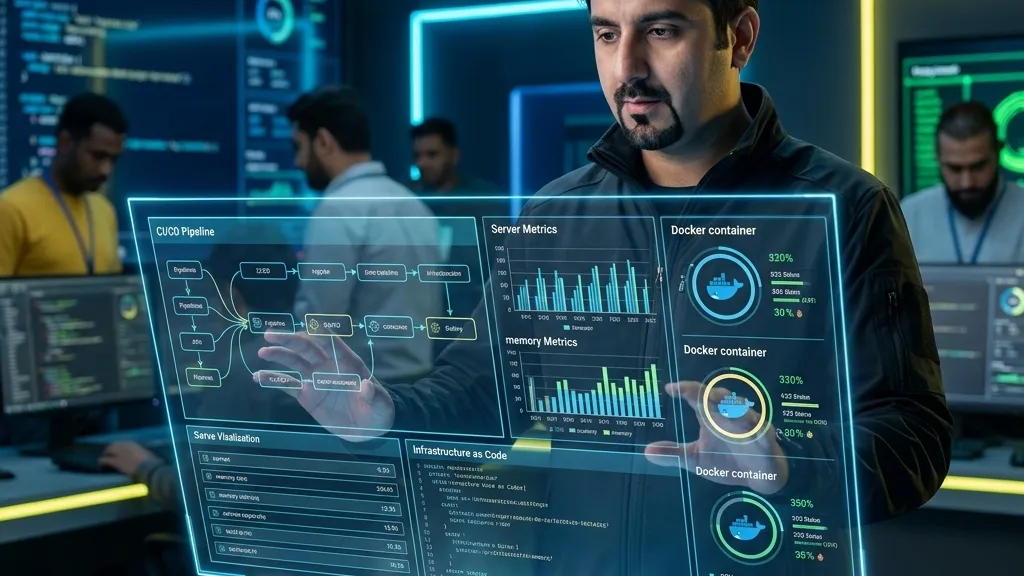
What Is Enterprise DevOps & Cloud Automation?
DevOps Engineering & Cloud Automation is an enterprise software operations discipline that codifies infrastructure and delivery pipelines. By orchestrating Infrastructure as Code (Terraform), hardened containerization (Docker, Kubernetes), and GitOps CI/CD release automation, it eliminates configuration drift, guarantees zero-downtime Blue/Green deployments, and establishes sub-minute automated disaster recovery.
Production-Validated Operational Reliability & Speed
Engineered for rapid deployment cycles, zero-downtime upgrades, and sub-minute recovery.
Critical DevOps Architectural Challenges & Operational Traps
Four systemic infrastructure failure points that trigger configuration drift, downtime outages, and container security breaches.
Manual Console Edits & Configuration Drift
Clicking through cloud consoles produces unrepeatable snowflakes, undocumented firewall holes, and failed disaster recovery drills. I enforce 100% Terraform Infrastructure as Code with automated daily drift detection pipelines.
High-Risk Releases & Maintenance Windows
In-place application upgrades stop servers and force users into multi-hour maintenance windows with high rollback failure rates. I implement automated Blue/Green and Canary releases that switch traffic only after green environments pass synthetic checks.
Bloated Containers & Vulnerable Root Runtimes
Deploying multi-gigabyte Docker images running as root introduces critical CVE vulnerabilities and slow pod boot times. I author multi-stage distroless Docker builds running non-privileged users with automated vulnerability gates.
Siloed Observability & Alert Fatigue
Disconnected logs, unindexed traces, and hundreds of false-positive alerts cause engineering burnout while critical production outages go undetected. I implement unified OpenTelemetry collection with actionable SLI/SLO threshold alerts.
Engineered Architecture: Production GitOps Pipeline & Cluster Topology
Technical Blueprint
Eliminating Human Error Through Declarative Cloud Automation
Manual cloud server configurations inevitably lead to production outages, inconsistent environments, and security vulnerabilities. In my architecture practice, DevOps automation provides the reliable foundation for high-availability backends in Laravel, cloud infrastructure on AWS and Google Cloud, and source control on GitHub.
# Production GitOps CI/CD & Zero-Downtime Release Flow
[Git Commit / Pull Request] → [GitHub Actions Automated CI Validation Gates]
• Security Scans → [Trivy CVE & SonarQube Static Code Analysis]
• Automated Tests → [Unit, Integration & End-to-End Test Pyramids]
• Image Build → [Multi-Stage Minimal Dockerfile & Cosign Image Signature]
→ Pushes to [Private Container Registry: AWS ECR / Artifact Registry]
→ [GitOps Reconciler: ArgoCD / Automated CD Engine Pulls Manifests]
→ Deploys to [Kubernetes Cluster / AWS ECS Fargate Infrastructure]
• Provisons Green Environment → [Executes Synthetic Smoke & Health Probes]
• Shifts Traffic → [ALB / Service Mesh Switches 100% Traffic Zero-Downtime]
→ [Unified Observability]: OpenTelemetry → Prometheus, Grafana & Datadog
Modular Terraform Infrastructure as Code
Cloud environments across AWS, GCP, and OCI are declared in reusable, version-controlled modules with remote S3 state locking and automated pull request plan validations.
Kubernetes Container Orchestration
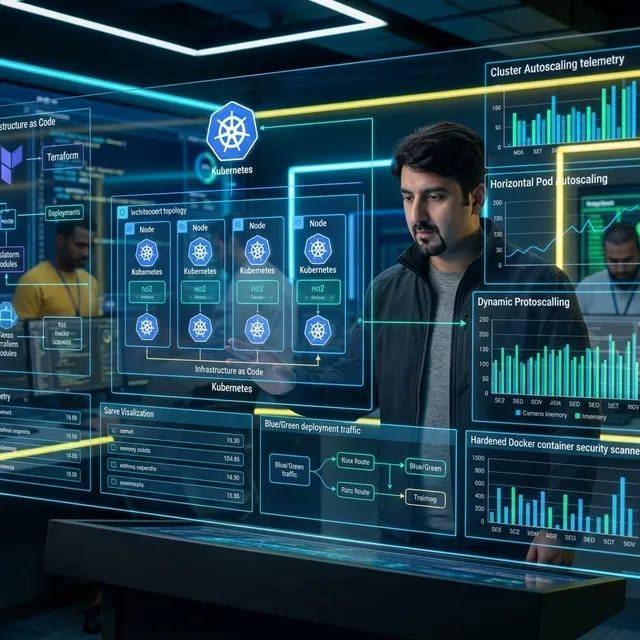
Managed Kubernetes clusters (EKS/GKE) configured with Pod Disruption Budgets, Horizontal Pod Autoscaling (HPA), and strict network policies for compute isolation.
Zero-Downtime Blue/Green Deployments
Routing traffic across application load balancers and service meshes, ensuring end users experience zero request drops or dropped sessions during releases.
Hardened Container Security Perimeter
Non-root multi-stage Docker builds utilizing minimal base images, automated Trivy CVE scanning in CI/CD, and cryptographically signed image digests.
Authoritative Architecture Standard
“Terraform is an infrastructure as code tool that lets you build, change, and version cloud and on-premises resources safely and efficiently. HashiCorp Terraform is an open source tool that codifies APIs into declarative configuration files.”
Every DevOps platform I engineer adheres directly to official industry standards: declarative Infrastructure as Code, OCI-compliant container immutability, automated security policy gates, and vendor-neutral OpenTelemetry instrumentation.
DevOps Operating Model: Architecture & Methodology Evaluation
Comparing enterprise GitOps and container automation against ad-hoc scripts and manual cloud console administration.
| Architectural Dimension | Engineered DevOps & GitOps (iGoher Standard) | Ad-Hoc Scripted Deployments | Manual Cloud Console (ClickOps) |
|---|---|---|---|
| Infrastructure Management Model | 100% Declarative Terraform modules with state locking & automated plan gates. | Fragmented Bash scripts requiring manual execution and variable overrides. | Manual browser clicks creating undocumented snowflakes and configuration drift. |
| Release Safety & Deployment Downtime | Zero-downtime automated Blue/Green & Canary traffic switching with health checks. | In-place service stops causing 10-30 minute downtime and risky rollbacks. | Manual server updates during scheduled night maintenance windows. |
| Container Hardening & Image Security | Multi-stage non-root distroless images with automated CVE block gates. | Standard base images with bloated dev dependencies and root execution. | Uncontainerized applications directly on long-lived mutable VM hosts. |
| Autoscaling & Self-Healing | Horizontal Pod Autoscaling (HPA) and automatic node provisioning in sub-minute. | Fixed VM limits requiring manual capacity increases during traffic surges. | Static unmanaged servers that crash under unexpected visitor spikes. |
| Observability & Incident Telemetry | Unified OpenTelemetry traces, Prometheus metrics, and automated SLI/SLO alerts. | Siloed log files on local disks requiring manual SSH inspection. | Default cloud provider CPU metrics without application-level tracing. |
| Disaster Recovery (RTO / RPO) | Deterministic cluster redeployment from Git and Terraform in under 15 minutes. | Manual server rebuilding and configuration taking multiple hours. | Unverified manual snapshots with high data loss risk and multi-day recovery. |
Implementation Lifecycle
Structured 4-Phase DevOps Architecture Delivery Process
A predictable, phased engineering roadmap taking infrastructure from fragile manual operations into fully automated, self-healing cloud platforms.
- Phase 01
Discovery & Topology Audit
Audit existing cloud resources, deployment bottlenecks, secrets management, and container configurations to map the target automated infrastructure architecture.
Duration: Week 1
- Phase 02
Terraform IaC & Containerization
Author modular Terraform configurations, codify VPC networks and managed databases, author hardened multi-stage Dockerfiles, and establish private registries.
Duration: Weeks 2–3
- Phase 03
Orchestration & GitOps CI/CD
Provision managed Kubernetes (EKS/GKE) or ECS clusters, establish GitOps delivery controllers (ArgoCD), and configure automated Blue/Green release pipelines.
Duration: Weeks 4–5
- Phase 04
Observability & DR Cutover
Deploy OpenTelemetry collectors, configure Prometheus metrics and Grafana dashboards, execute zero-downtime DNS cutover, and verify disaster recovery automation.
Duration: Week 6
Core DevOps Architectural Modules I Engineer
Authoritative implementation across declarative cloud provisioning, container orchestration, zero-downtime release automation, and full-stack observability.
Terraform Infrastructure as Code
Codifying cloud environments across AWS, GCP, and OCI into modular, version-controlled Terraform modules with remote state locking and automated plan validations.
Kubernetes Container Orchestration
Architecting auto-scaling container clusters (Amazon EKS, GKE Autopilot) with Pod Disruption Budgets, network policies, and horizontal pod autoscaling (HPA).
Zero-Downtime Blue/Green Releases
Orchestrating traffic switching behind application load balancers and service meshes, ensuring end users experience zero request drops during production updates.
Hardened Container Security
Building non-root multi-stage Docker containers with minimal base images (Alpine/Distroless), automated CVE scanning, and immutable image digests.
GitOps Continuous Delivery
Synchronizing cluster configuration directly from Git repositories using ArgoCD or GitHub Actions, guaranteeing that production state strictly mirrors code.
Full-Stack Telemetry & Observability
Instrumenting distributed systems with OpenTelemetry, Prometheus metrics, Grafana dashboards, and automated alert routing for proactive incident prevention.
Automated Drift Detection
Scheduled GitHub Actions workflows execute daily terraform plan checks, automatically alerting teams to out-of-band manual cloud console changes.
Policy as Code (OPA / Conftest)
Open Policy Agent (OPA) gates inspect Terraform plans and Kubernetes manifests before deployment, rejecting configurations that expose unencrypted volumes or public buckets.
Automated Chaos Engineering Drills
Simulating sudden worker node terminations, zone disconnects, and packet loss to prove that container autoscaling and database failover operate flawlessly under stress.
Production DevOps Technology Stack Architecture Matrix
A comprehensive overview of the technological layers and automation tools engineered in every enterprise DevOps deployment.
Infrastructure as Code (IaC)
Terraform, OpenTofu, Terragrunt, AWS CloudFormation, and HashiCorp Cloud Platform.
Container Orchestration
Kubernetes (EKS, GKE, AKS), AWS ECS Fargate, Google Cloud Run, and Docker Engine.
CI/CD & GitOps Automation
GitHub Actions, ArgoCD, Flux CD, GitLab CI, and Fastlane for mobile builds.
Container & Code Security
Trivy vulnerability scanner, Cosign image signing, Grype, SonarQube, and Open Policy Agent.
Observability & Telemetry
OpenTelemetry, Prometheus, Grafana Cloud, Datadog APM, and AWS CloudWatch.
Secrets & Governance
HashiCorp Vault, AWS Secrets Manager, GitHub OIDC federation, and SOPS encrypted secrets.
Architectural Glossary
Core DevOps Technical Definitions & Concepts
Authoritative definitions of fundamental infrastructure automation mechanisms, container standards, and deployment models.
- Infrastructure as Code (IaC)
- Infrastructure as Code is defined as the practice of managing and provisioning computing infrastructure through machine-readable definition files (such as Terraform), rather than manual physical hardware or interactive console configurations.
- Kubernetes Orchestration
- Kubernetes (K8s) is defined as an open-source container orchestration engine that automates computer application deployment, scaling, healing, and management across clustered server environments.
- Blue/Green Deployment
- Blue/Green Deployment is defined as a release management methodology that provisions two identical production environments (Blue and Green), routing all active traffic to one while deploying and testing the new release on the other before switching router endpoints with zero downtime.
- GitOps Continuous Delivery
- GitOps is defined as an operational framework where Git repositories serve as the single source of truth for declarative infrastructure and application state, using automated reconcilers to continuously synchronize live clusters with code.
- OpenTelemetry (OTel)
- OpenTelemetry is defined as a vendor-neutral observability framework that provides standardized APIs, libraries, and instrumentation agents to collect, process, and forward distributed traces, metrics, and logs from microservices.
- Docker Multi-Stage Builds
- Multi-Stage Builds is defined as a Docker optimization technique that uses multiple FROM statements in a single Dockerfile to isolate heavy compilers, dev dependencies, and build tools into intermediate stages, producing minimal, secure production container images.
Complementary Technologies & Service Ecosystem
Explore related cloud, container, and engineering disciplines across my technical architecture portfolio.
Git & GitHub Architecture
Trunk-based workflows, GitHub Actions matrix CI/CD, and secret-less OIDC cloud federation.
Amazon AWS Cloud Infrastructure
Multi-AZ AWS EKS Kubernetes clusters, ECS Fargate, Aurora PostgreSQL, and Terraform automation.
Google Cloud (GCP) Architecture
GKE Autopilot, serverless Cloud Run microservices, Artifact Registry, and Cloud Build pipelines.
Cloudflare Edge Infrastructure
Edge computing via Cloudflare Workers, DDoS mitigation, and Zero Trust access with Tunnels.
Laravel Backend Architecture
High-concurrency API backends, Horizon queue workers, and Filament admin systems on containers.
Enterprise IT Consultancy Services
End-to-end cloud architecture design, legacy migration blueprints, security audits, and reviews.
Authoritative References & Documentation
- Terraform Documentation — Declarative Infrastructure as Code language specifications and provider architecture.
- Kubernetes Documentation — Production container orchestration, networking, workloads, and cluster management.
- Docker Documentation — Container engine fundamentals, multi-stage build optimization, and security practices.
- OpenTelemetry Documentation — Vendor-neutral distributed telemetry, tracing, and metric collection standards.
DevOps Guidance
Frequently Asked Questions on Enterprise DevOps & Cloud Operations
Direct answers to critical questions regarding cloud migration, containerization, and automated release safety.
How do I achieve true zero-downtime production deployments for high-traffic applications?
I implement automated Blue/Green deployments or Canary release strategies orchestrated through Kubernetes (ArgoCD / Flagger) or AWS ECS Application Load Balancers. New application versions are booted and verified against automated synthetic health checks before traffic is gradually shifted from the existing (Blue) tier to the new (Green) tier, completely eliminating user drop-offs.
Why is Infrastructure as Code (IaC) with Terraform essential for enterprise cloud operations?
Manual cloud console configuration produces configuration drift, undocumented infrastructure dependencies, and human error. With Terraform, every VPC, firewall rule, database instance, and container cluster is declared in modular, version-controlled code. This enables reproducible staging environments and guarantees fast disaster recovery reconstruction in minutes.
How do I secure Docker containers against vulnerabilities in production?
I design minimal, multi-stage Dockerfiles based on hardened distroless or Alpine images. Containers run strictly as non-privileged users with read-only root filesystems and dropped Linux capabilities. Automated CI/CD scanners (Trivy, Grype) block container pushes if critical CVE vulnerabilities are detected.
When should an organization migrate from standalone VMs to Kubernetes or serverless containers?
I recommend migrating to container runtimes (AWS ECS Fargate or Google Cloud Run) when teams experience deployment friction, slow scaling response times, or environment drift between local dev and production. For complex multi-service topologies requiring service meshes, fine-grained networking, and automated horizontal pod autoscaling, I deploy managed Kubernetes (EKS or GKE Autopilot).
How do I structure comprehensive observability (metrics, logs, traces) across distributed microservices?
I configure unified OpenTelemetry instrumentation. Application traces, Prometheus container metrics, and structured JSON logs are shipped to centralized telemetry backends (Datadog, Grafana Cloud, or AWS CloudWatch). Automated SLI/SLO dashboards and PagerDuty alert triggers notify engineers of anomalies before customers are affected.
How do GitOps pipelines eliminate configuration drift between code and live infrastructure?
GitOps establishes a single source of truth in Git repositories. An in-cluster agent (such as ArgoCD) continuously monitors live cluster state against declared Git manifests. Any unauthorized manual changes made in production are automatically detected, alerted, and reconciled back to the declared Git state without human intervention.
How do I manage database migrations safely during automated continuous deployments?
I enforce non-blocking expand-and-contract migration patterns. New database columns and tables are created ahead of application code deployment, code is updated to read and write to new fields, and old database fields are deprecated only after all microservices are running the latest version. This prevents deployment downtime and lockups on transactional tables.
How does DevOps engineering integrate into my broader full-stack and cloud practice?
DevOps is the operational engine uniting all software engineering disciplines. I design the deployment pipelines and cloud infrastructure supporting high-performance Laravel backends, modern Astro web frontends, and Flutter mobile applications, documented across my IT Consultancy and Cloud Infrastructure Practices.
Let’s Connect
Ready to Automate Your Infrastructure with Modern DevOps?
Schedule a direct technical consultation with an enterprise DevOps architect. Discuss your Kubernetes rollout, Terraform automation, or zero-downtime CI/CD deployment goals with clear engineering milestones.