

Modern Styling Architecture & Design Tokens
Tailwind CSS & Vanilla CSS Architecture & Frontend Design Systems
Scalable enterprise design tokens, zero-runtime stylesheet compilation, fluid responsive typography, and accessible multi-theme architectures that deliver sub-15KB production bundles.

What Is Enterprise Tailwind & Vanilla CSS Architecture?
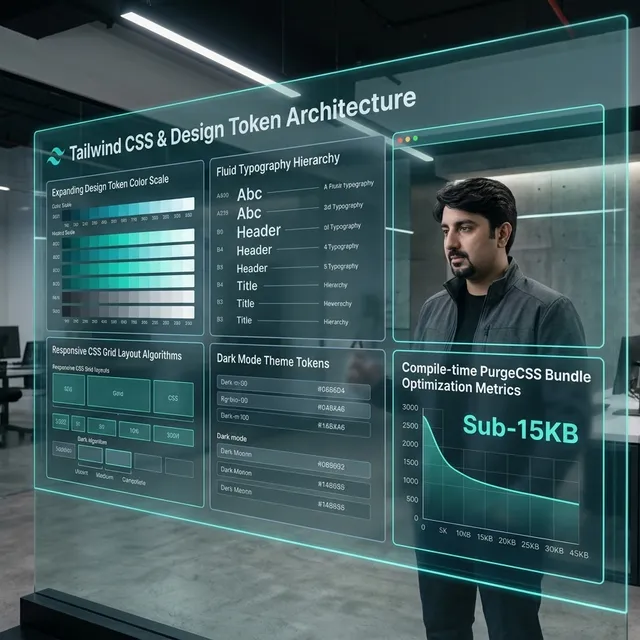
Tailwind CSS & Vanilla CSS Architecture is a modern frontend styling discipline that builds scalable, deterministic design systems. By compiling atomic utility classes at build time and leveraging CSS custom properties, it completely eliminates runtime JavaScript overhead, prevents cascade conflicts, and delivers sub-15KB production stylesheets with 100% WCAG-compliant theming.
Production-Validated Styling Reliability & Performance
Engineered for instant stylesheet delivery, zero render-blocking delays, and pristine visual consistency.
Critical CSS Architectural Challenges & Performance Traps
Four systemic stylesheet failure points that trigger severe layout shifts, specificity wars, and bundle bloat.
Specificity Wars & Cascade Regressions
Deeply nested SASS rules and global BEM overrides create fragile selector battles where updating one component breaks layouts across unrelated pages. I enforce atomic utility classes that compose styling directly in markup without global specificity conflicts.
CSS-in-JS Runtime Parsing & Layout Jitter
Runtime CSS-in-JS libraries force client browsers to parse, compute, and inject styles via JavaScript on the main thread, causing severe layout jank on low-end mobile devices. I replace runtime CSS with compile-time utility extraction.
Unbounded Stylesheet Bloat & Slow FCP
Traditional monolithic stylesheets grow linearly with every new feature, resulting in 200KB+ CSS files that block browser rendering. I implement automated compile-time dead-code elimination that caps production stylesheets under 15KB.
Inconsistent Ad-Hoc Values & Token Drift
Allowing developers to write arbitrary pixel values and hardcoded hex colors fractures brand consistency. I establish immutable design tokens in configuration files, restricting all layouts, typography, and colors to defined scales.
Engineered Architecture: Design Token Pipeline & Build Optimization
Technical Blueprint
Delivering Visual Distinction with Zero Runtime Penalties
A bloated stylesheet is one of the primary culprits behind sluggish First Contentful Paint times and poor mobile responsiveness. In my engineering practice, Tailwind CSS is integrated directly with modern frontend engines like Astro and served across global edge CDNs on Cloudflare.
# Production Design Token & Compile-Time CSS Pipeline Flow
[Design Specs & Brand Tokens] → [Configuration Layer: tailwind.config & CSS Variables]
→ Scans Templates → [Astro Components, HTML Markup & Markdown Files]
→ Compiler Processing → [PostCSS & Tailwind JIT Compilation Engine]
• Dead-Code Elimination → [Discards 100% of Unused Utility Rules]
• Minification & Autoprefixing → [Generates Static Sub-15KB Production CSS]
• Fluid Scaling → [Applies clamp() Responsive Typography & Spacing]
→ Edge CDN Distribution → [Cloudflare Global Edge Cache with Gzip/Brotli]
→ [Browser Rendering]: Zero Runtime JS Parsing, 0.00 CLS & 60fps GPU Compositing
Immutable Design Token Architecture
Design tokens defining brand colors, fluid typography clamps, spacing scales, and container breakpoints represent the authoritative single source of truth.
Compile-Time Utility Scanning & Purging
Tailwind static scanner parses AST template files to extract exact classes used, completely discarding unused rules and keeping CSS payloads minimal.
Semantic Multi-Theme Variables
CSS custom properties enable instant switching between light, dark, and high-contrast modes with zero component re-renders or layout recalculations.
Hardware-Accelerated Micro-Interactions
Handcrafted Vanilla CSS keyframe animations leveraging GPU-composited transform and opacity layers for fluid 60fps interaction feedback.
Authoritative Architecture Standard
“A utility-first CSS framework packed with classes like flex, pt-4, text-center and rotate-90 that can be composed to build any design, directly in your markup.”
Every styling architecture I deploy adheres directly to official CSS and Tailwind specifications: zero runtime JavaScript overhead, strict design token encapsulation, full WCAG 2.1 contrast compliance, and sub-15KB production footprints.
Styling Operating Model: Architecture & Methodology Evaluation
Comparing utility-first Tailwind architecture against runtime CSS-in-JS and traditional SASS/BEM stylesheets.
| Architectural Dimension | Tailwind CSS (Utility-First) | CSS-in-JS (Emotion / Styled) | Traditional SASS / BEM |
|---|---|---|---|
| Runtime JS Overhead | 0 ms (Pure Static Compiled CSS parsed immediately by browser) | 10 - 50 ms Evaluation (JavaScript thread blocking on client) | 0 ms (Pure Static CSS but often bloated with unused rules) |
| Production Bundle Size | Tiny (< 15 KB Flat regardless of project size and scope) | Grows linearly with JavaScript application bundle size | Monolithic (> 150 KB with difficult manual purging) |
| CSS Specificity Conflicts | Zero (Flat single-class utility model prevents cascade bugs) | Zero (Scoped random hash class names prevent leakage) | High (Deep cascade rules and fragile specificity wars) |
| Dead-Code Purging | Automatic compile-time AST scanning purges 100% of unused styles | Requires complex JS tree-shaking that frequently misses styles | Difficult manual audits resulting in abandoned dead CSS rules |
| Mobile Render Blocking | Negligible (< 10ms First Contentful Paint delay) | Significant on budget mobile devices and slow CPUs | Moderate (Large monolithic CSS files delay rendering) |
| Design System Enforcement | Strict configuration tokens prevent ad-hoc pixel values | Varies by implementation; often lacks strict scale constraints | Relies entirely on developer discipline and code reviews |
Implementation Lifecycle
Structured 4-Phase CSS Architecture Delivery Process
A predictable, phased engineering roadmap transforming fragile, bloated stylesheets into ultra-lean, production-hardened design token systems.
- Phase 01
Token Audit & Calibration
Audit brand identity, design mockups, and existing stylesheets to extract unified color tokens, typography scales, spacing grids, and contrast ratios.
Duration: Week 1
- Phase 02
Config & Component Tokens
Construct central Tailwind configuration, define semantic CSS custom properties for theming, and build foundational accessible UI primitives.
Duration: Weeks 2–3
- Phase 03
Layouts & Micro-Animations
Implement responsive CSS Grid and Flexbox layouts, fluid typography clamp calculations, and handcrafted Vanilla CSS hardware-accelerated animations.
Duration: Weeks 4–5
- Phase 04
Purging & CLS Verification
Execute compile-time dead-code purging, conduct axe-core accessibility contrast verification, eliminate layout shifts (CLS), and achieve sub-15KB bundle delivery.
Duration: Week 6
Core Styling Architectural Modules I Engineer
Authoritative implementation across design token systems, compile-time optimizations, accessible theming, and fluid layouts.
Utility-First Determinism
Atomic utility classes compose styling directly in markup, eliminating global cascade conflicts, selector specificity wars, and CSS regression risks.
Centralized Design Tokens
Single-source-of-truth configuration for colors, spacing scales, typography hierarchies, and border radii ensures strict visual coherence across complex applications.
Zero Runtime Overhead
Unlike CSS-in-JS runtimes, Tailwind operates purely at build time. Style rules are compiled into a static, highly compressed CSS file that browsers parse instantly.
Semantic Dark Mode Theming
Leveraging CSS custom properties to switch between light, dark, and high-contrast accessibility modes instantly without re-rendering component trees.
Modern Grid & Flexbox Layouts
Building responsive layouts with modern CSS Grid and Flexbox primitives, ensuring visual adaptation from 320px mobile screens to 4K ultra-wide monitors.
Hardware-Accelerated Animation
Handcrafted Vanilla CSS keyframe animations utilizing GPU-composited transform and opacity properties for fluid 60fps micro-interactions.
WCAG Contrast Auditing
Automated linting and axe-core accessibility scanners inspect color token combinations to guarantee that contrast ratios satisfy WCAG 2.1 AA/AAA standards.
Cumulative Layout Shift (CLS) 0.00
Enforcing strict aspect-ratio utility wrappers, font-display: swap fallbacks with adjusted metrics, and explicit dimensions to achieve a rock-solid 0.00 CLS score.
Fluid Typography & Scaling
Combining CSS clamp() calculations with Tailwind screen modifiers, ensuring typography and component margins scale smoothly across viewports without abrupt jumps.
Production Styling Technology Stack Architecture Matrix
A comprehensive overview of the technological layers and build tools engineered in every enterprise CSS deployment.
Utility Compilation Engine
Tailwind CSS 3.x / 4.x JIT compiler, PostCSS preprocessor, and Lightning CSS minification.
Design Token System
Figma token synchronization, tailwind.config token mapping, and semantic CSS variables.
Layout & Typography Primitives
CSS Grid, Flexbox, Container Queries, and fluid typography calculations with clamp().
Accessibility & Theming
WCAG 2.1 AA/AAA contrast auditing, semantic dark mode, and reduced-motion media queries.
Animation & Acceleration
GPU-composited CSS keyframes, will-change hints, cubic-bezier easing, and micro-interactions.
Quality & Optimization
Compile-time dead-code purging, axe-core automated scanners, 0.00 CLS layout bounds, and edge caching.
Architectural Glossary
Core CSS & Styling Technical Definitions
Authoritative definitions of foundational styling mechanisms, design tokens, and CSS layout algorithms.
- Utility-First CSS
- Utility-First CSS is defined as a styling architectural pattern where single-purpose, highly composable classes (e.g., flex, pt-4, text-center) are applied directly to HTML markup, eliminating custom stylesheet authoring.
- Design Tokens
- Design Tokens are defined as platform-agnostic design decisions represented as key-value pairs (colors, typography scales, spacing units) that serve as the single source of truth for UI consistency.
- Dead-Code Elimination (Purging)
- Purging is defined as the compile-time optimization process that scans application templates for used class names and removes every unused CSS rule from the final production bundle.
- CSS Custom Properties (Variables)
- CSS Custom Properties are defined as user-defined cascading variables evaluated at browser runtime, enabling dynamic theme switching, fluid spacing, and computed styling across the DOM tree.
- Cumulative Layout Shift (CLS)
- CLS is defined as a Google Core Web Vital metric measuring unexpected visual layout shifts during page loading, caused by un-dimensioned images, dynamic ads, or late-loading web fonts.
- PostCSS Processor
- PostCSS is defined as a JavaScript-based build tool that transforms CSS styles with plugins, handling vendor autoprefixing, nesting resolution, and Tailwind utility compilation during build cycles.
Complementary Technologies & Service Ecosystem
Explore related frontend, cloud, and architecture technologies across my engineering portfolio.
Astro Web Framework
Zero-JS Islands Architecture paired with Tailwind CSS for 100/100 Core Web Vitals and lightning-fast loading.
Cloudflare Edge Infrastructure
Sub-millisecond asset caching, edge compression, and global distribution for static web applications.
Dart & Flutter Mobile Engineering
Translating design tokens into native iOS and Android widget design systems with pixel-perfect precision.
Enterprise Web Development
Custom corporate web platforms, design system implementation, and performance-driven frontend builds.
Data-Driven SEO Services
Technical SEO enhancements, Core Web Vitals optimization, semantic schema markup, and speed auditing.
Enterprise IT Consultancy
UI architecture reviews, frontend modernization roadmaps, design-to-code pipelines, and consulting.
Authoritative References & Documentation
- Tailwind CSS Documentation — Utility-first fundamentals, configuration APIs, and core plugin specifications.
- MDN Web Docs: CSS — Official specifications for modern CSS Grid, Flexbox, custom properties, and animations.
- W3C WCAG Guidelines — Web Content Accessibility Guidelines for color contrast and visual readability.
- PostCSS Tooling — CSS transformation ecosystem, AST processing, and build-time optimization plugins.
Styling Guidance
Frequently Asked Questions on Tailwind & CSS Architecture
Direct answers to critical questions about design tokens, performance tradeoffs, and enterprise UI scalability.
Why choose Tailwind CSS over traditional CSS preprocessors or runtime CSS-in-JS?
CSS-in-JS libraries (Emotion, styled-components) impose heavy JavaScript runtime parsing costs, layout recalculation thrash, and bundle bloat that degrades mobile performance. Tailwind CSS operates strictly as a compile-time engine, generating atomic utility classes with zero runtime JavaScript overhead, resulting in minified production stylesheets typically under 15KB.
How do I maintain consistent design systems and brand tokens across enterprise applications?
I configure Tailwind CSS design tokens—such as unified color palettes, typography scales, container breakpoints, and shadow elevations—directly within tailwind.config.cjs or modern CSS custom properties. This establishes an immutable design system contract that prevents arbitrary ad-hoc inline styles and maintains brand coherence across distributed engineering teams.
When is handcrafted Vanilla CSS preferred alongside Tailwind utility classes?
While Tailwind excels at structural layouts, responsive grids, and typography, I implement Vanilla CSS for complex hardware-accelerated animations (CSS keyframes), fluid typography algorithms with clamp(), advanced SVG clip-paths, and custom scrollbar theming. Combining both yields maximum engineering speed with bespoke visual refinement.
How do I architect dark mode and accessible color contrast across multi-theme platforms?
I implement semantic CSS custom properties coupled with Tailwind class-based dark mode strategy. Contrast ratios are strictly calibrated to WCAG 2.1 AA/AAA compliance standards across both light and dark themes, ensuring full readability and accessibility for all users.
How does Tailwind CSS eliminate unused styles during production builds?
Tailwind static scanner parses all template files (Astro, HTML, JSX, Vue) to extract every utility class in use. It purges 100% of unused styles at compile time, eliminating stylesheet bloat regardless of project size and ensuring lightning-fast First Contentful Paint (FCP) metrics.
How do I eliminate Cumulative Layout Shift (CLS) in high-traffic responsive interfaces?
I eliminate CLS by enforcing strict aspect-ratio utility wrappers on media containers, using font-display: swap with matched font fallback metrics (size-adjust, ascent-override), and defining explicit min-height values on dynamic layout containers to prevent content jumps.
Can Tailwind CSS components be reused across different frontend frameworks?
Yes. Because Tailwind utility classes are plain HTML strings, component styling is completely portable. Design tokens and UI patterns authored in Astro can be ported directly into Laravel Blade templates or React components without modifying stylesheet bundles or introducing runtime dependencies.
How does modern CSS architecture integrate into my broader full-stack services?
Clean CSS architecture is foundational to user experience, conversion rates, and SEO performance. I integrate Tailwind and modern CSS across high-performance web frontends built with Astro, Laravel Blade views, and interactive React applications, documented across my Web Development and Technical SEO Practices.
Let’s Connect
Ready to Build a High-Performance Design System?
Schedule a direct technical consultation with an enterprise frontend architect. Discuss your design system unification, CSS performance optimization, or UI modernization with clear engineering milestones.