

High-Throughput Runtimes & Microservices
Node.js Backend Architecture Consulting & Microservices Engineering
Scalable event-driven backends, non-blocking asynchronous I/O architectures, real-time WebSocket communication pipelines, and type-safe TypeScript microservices built for enterprise concurrency.

What Is Node.js Backend Architecture Consulting?
Node.js Backend Architecture Consulting is an enterprise software engineering discipline that designs, optimizes, and scales non-blocking asynchronous systems on the V8 runtime. It unifies strict TypeScript validation, high-throughput frameworks (Fastify, NestJS), real-time WebSockets, and distributed BullMQ queues to handle 50,000+ concurrent connections with sub-15ms latency.
Production-Validated Node.js Performance
Engineered for high-volume transactions, sub-millisecond event loops, and minimal memory footprints.
Critical Node.js Architectural Challenges & Performance Traps
Four systemic runtime and concurrency failure points that trigger event loop lag, memory leaks, and service downtime.
Event Loop Starvation & CPU Blocking
Executing intensive synchronous computations (cryptographic hashing, image manipulation, large JSON parsing) blocks the single thread. I offload heavy computation to Worker Threads and separate asynchronous worker processes.
Unhandled Rejections & Process Failures
Missing error boundaries around asynchronous Promises trigger unhandledRejection events that crash Node.js process instances. I enforce structured error handling with custom domain exceptions and centralized process monitors.
Hidden Memory Leaks & Event Listeners
Accumulating un-garbage-collected event listeners, unbounded global caches, or circular closures slowly exhausts server RAM. I instrument automated heap profiling and OpenTelemetry telemetry to isolate leaks before crashes occur.
NPM Supply-Chain Vulnerabilities
Deep transitive dependency trees in npm expose production environments to compromised packages and malicious code injections. I enforce strict package-lock.json hashing, Snyk security audits, and minimal container base images.
Engineered Architecture: Production Topology & Security Perimeter
Technical Blueprint
Connecting High-Concurrency Runtimes with Enterprise Data
Modern digital ecosystems demand backend runtimes capable of managing real-time data feeds, AI agent orchestration, and sub-millisecond API endpoints. In my practice, Node.js is deployed in concert with relational database engines and container automation.
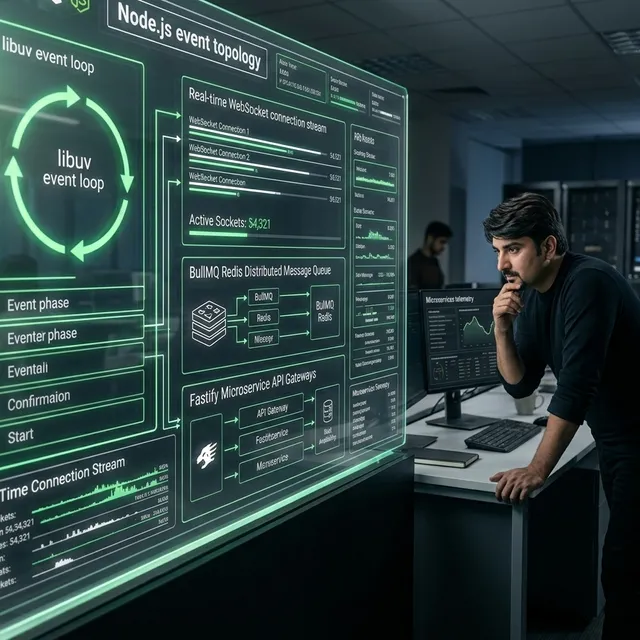
# Production Traffic & Asynchronous Execution Flow
[Client Ingress / WebSockets] → (Global Edge Load Balancer / TLS Termination)
→ [Fastify / NestJS API Gateway Layer (TypeScript Strict)]
• Non-Blocking Event Loop (libuv Asynchronous I/O Execution)
• Real-Time Socket Broadcast → [Redis Pub/Sub Cluster Backplane]
• Heavy Background Jobs → [BullMQ Distributed Queue Pipeline]
• CPU-Bound Workers: Worker Threads & Standalone Queue Pods
• Data Tier: PostgreSQL / MySQL with Connection Pool Multiplexing
→ [Observability]: OpenTelemetry Telemetry & Event Loop Lag Alarms
Stateless Horizontal Container Pods
Node.js services operate in stateless Alpine Docker containers deployed across AWS ECS Fargate or Google Cloud Run, autoscaling dynamically based on CPU and request volume.
Redis Pub/Sub WebSocket Clustering
Real-time WebSocket channels broadcast bi-directionally across distributed server pods via Redis message backplanes, supporting millions of active socket subscriptions.
Resilient Database Connection Multiplexing
Configuring connection pooling limits and database proxies prevents backend saturation when hundreds of asynchronous microservices query PostgreSQL or MySQL instances simultaneously.
Distributed BullMQ Workload Isolation
Decoupling heavy background workloads into BullMQ Redis queues ensures HTTP endpoints maintain sub-15ms response times while worker clusters process intensive tasks.
Authoritative Architecture Standard
“Node.js is an open-source, cross-platform JavaScript runtime environment that executes JavaScript code outside a web browser. As an asynchronous event-driven JavaScript runtime, Node.js is designed to build scalable network applications.”
Every Node.js architecture I engineer adheres directly to the official runtime specifications: maintaining zero event loop blocking through asynchronous patterns, enforcing strong typing via TypeScript, and packaging minimal container images for production reliability.
Backend Runtime Operating Model: Prototype vs Engineered Node.js
Comparing ad-hoc unstructured JavaScript codebases against enterprise, TypeScript-governed Node.js architectures.
| Architectural Dimension | Engineered Node.js Architecture (iGoher Standard) | Unmanaged Express Prototype | Generic Script Framework Stack |
|---|---|---|---|
| Concurrency & Event Loop | Strictly non-blocking event loop with Worker Threads for CPU tasks and sub-15ms latency. | Synchronous file parsing and loops blocking the single thread, stalling user requests. | Unoptimized event handling with frequent thread starvation and high request timeouts. |
| Type Safety & Domain Design | 100% strict TypeScript compilation with Zod validation and structured NestJS/Fastify layers. | Untyped plain JavaScript with undefined is not a function runtime crashes in production. | Partial type checking with missing interfaces and fragile runtime boundary handling. |
| WebSocket & Real-Time Sync | Bi-directional WebSocket topologies clustered across Redis Pub/Sub for horizontal scaling. | Single-instance in-memory socket state that loses synchronization during multiple pod scaling. | Heavy HTTP polling intervals that flood server bandwidth and exhaust database connections. |
| Queue & Asynchronous Processing | BullMQ distributed queues with Redis persistence, exponential retries, and telemetry. | In-memory setTimeout or setImmediate arrays lost forever when container pods restart. | Ad-hoc cron tasks that run unmonitored with no automated dead-letter failure queues. |
| Memory & Performance Profiling | Continuous heap dump profiling, OpenTelemetry event loop monitoring, and leak isolation. | Memory leaks diagnosed only when Kubernetes kills pods due to Out-Of-Memory (OOM) alerts. | Zero telemetry into active handles or garbage collection pauses during peak volume. |
| Dependency Supply Chain | Strict package-lock.json hashing, Snyk CI/CD gates, and minimal non-root Docker images. | Unpinned package ranges (^ or ~) pulling untested minor updates directly during production deploys. | Vulnerable third-party libraries running as root user with open container file systems. |
Implementation Lifecycle
Structured 4-Phase Node.js Backend Delivery Process
A predictable, phased delivery roadmap transforming complex microservice requirements into scalable, enterprise-grade Node.js architectures.
- Phase 01
Discovery & Concurrency Audit
Analyze event loop lag, throughput requirements, API contract specifications, and database connection limits to establish engineering baselines.
Duration: Week 1
- Phase 02
TypeScript Architecture & Fastify
Construct structured domain services in strict TypeScript, implement Fastify or NestJS routing, and enforce schema validation using Zod.
Duration: Weeks 2–3
- Phase 03
WebSockets & BullMQ Queues
Cluster real-time WebSocket channels across Redis Pub/Sub, establish BullMQ background worker pools, and offload CPU tasks to Worker Threads.
Duration: Weeks 4–5
- Phase 04
Containerized CI/CD & Release
Deploy hardened Alpine Docker containers to AWS ECS or Google Cloud Run, configure OpenTelemetry APM dashboards, and complete knowledge transfer.
Duration: Week 6
Core Node.js Services & Architectural Modules
Authoritative implementation across event-driven runtimes, real-time channels, and distributed queues.
Non-Blocking Event Loop (libuv)
Leveraging libuv asynchronous I/O abstractions to process thousands of simultaneous database queries, HTTP calls, and file operations without thread-locking overhead.
Strict TypeScript Rigor
Eliminating whole classes of production bugs through strict compilation, Zod runtime payload validation, and typed domain entities across full-stack boundaries.
High-Performance Fastify Engines
Deploying Fastify and NestJS architectures with low routing overhead, automated schema serialization, and native plugin encapsulation for extreme throughput.
Real-Time WebSocket Streaming
Architecting bidirectional WebSocket topologies clustered across Redis Pub/Sub channels for instant multiplayer sync, live chat, and collaborative streaming apps.
Distributed BullMQ Queues
Isolating intensive background workloads using BullMQ and Redis queues with automatic exponential backoff retries, dead-letter storage, and telemetry.
Containerized Microservice Deployment
Packaging production Node.js services into hardened, multi-stage Alpine Docker images deployed across AWS ECS Fargate or Google Cloud Run with automated auto-scaling.
Worker Threads Parallelism
Offloading CPU-bound tasks, image encoding, and cryptographic operations to separate worker threads to keep the primary event loop completely responsive.
Database Connection Multiplexing
Optimizing database connection pool saturation using Prisma, Drizzle, or pg-pool to prevent backend connection exhaustion under massive traffic spikes.
OpenTelemetry APM Monitoring
Instrumenting distributed tracing, garbage collection tracking, and automated event loop delay alarms that alert teams before performance degrades.
Node.js Production Stack Architecture Matrix
A comprehensive overview of the technological layers and components engineered in every enterprise Node.js deployment.
Runtime & Engine
Node.js 20+ LTS, Google V8 JavaScript Engine, libuv asynchronous I/O, Worker Threads, and TypeScript 5.x.
Frameworks & APIs
Fastify, NestJS, Express, GraphQL (Yoga/Apollo), gRPC microservice protocols, and Zod runtime schema validation.
Real-Time & Caching
WebSockets (ws / Socket.io), Redis Pub/Sub message backplanes, Redis caching, and Server-Sent Events (SSE).
Databases & ORM
PostgreSQL, MySQL, MongoDB, Prisma ORM, Drizzle ORM, pg-pool connection management, and read-replica routing.
Queue & Workers
BullMQ distributed task queues, Redis cluster backends, automated dead-letter queues, and job telemetry.
DevOps & Observability
Docker multi-stage Alpine images, AWS ECS Fargate, Google Cloud Run, OpenTelemetry, Datadog, and Sentry.
Architectural Glossary
Core Node.js Technical Definitions & Concepts
Authoritative definitions of fundamental Node.js runtime mechanisms, asynchronous constructs, and architectural design patterns.
- Event Loop
- The Node.js Event Loop is defined as the core scheduling mechanism that enables non-blocking I/O operations by delegating system tasks to the operating system kernel via libuv and processing callbacks across distinct phases (timers, pending, poll, check).
- libuv Abstraction
- libuv is defined as a multi-platform C support library designed for Node.js that provides an asynchronous event loop, a cross-platform thread pool for file system operations, and asynchronous socket abstractions.
- Worker Threads
- Worker Threads is defined as a Node.js module that enables execution of parallel JavaScript code across multiple CPU threads sharing memory via SharedArrayBuffer, preventing heavy computations from blocking the primary event loop.
- Fastify Framework
- Fastify is defined as a high-performance, low-overhead Node.js web framework focused on maximizing throughput through optimized JSON schema compilation, asynchronous middleware pipelines, and structured logging.
- BullMQ
- BullMQ is defined as an enterprise-grade message and job queue library for Node.js backed by Redis, offering atomic job transitions, rate limiting, parent-child job workflows, and automated retries for distributed workloads.
- V8 JavaScript Engine
- The V8 Engine is defined as Google's open-source high-performance JavaScript and WebAssembly engine written in C++, compiling JavaScript source code directly into optimized native machine code using Just-In-Time (JIT) compilation.
Complementary Technologies & Service Ecosystem
Explore related backend, cloud, and AI technologies across my technical architecture portfolio.
Relational & Distributed Databases
PostgreSQL, MySQL, Prisma schema design, and Redis high-speed caching architectures.
AI Agent Architecture & Reasoning
Autonomous multi-agent orchestration, LangChain pipelines, and streaming LLM integration.
DevOps & Automated CI/CD
Docker containerization, automated testing pipelines, and Kubernetes orchestration for Node.js.
Amazon AWS Cloud Infrastructure
ECS Fargate container clusters, API Gateway, AWS Lambda serverless functions, and CloudWatch metrics.
Enterprise Web Development
Custom web platforms, modern API backends, and full-stack TypeScript architectures.
Enterprise IT Consultancy Services
Strategic software architecture reviews, microservice decomposition roadmaps, and consulting.
Authoritative References & Documentation
- Official Node.js Documentation — Asynchronous runtime APIs, event loop specifications, and module systems.
- V8 JavaScript Engine — Just-in-time compilation pipeline, memory allocation, and garbage collection mechanisms.
- Fastify Web Framework — High-throughput architecture, JSON schema compilation, and plugin lifecycle guides.
- BullMQ Documentation — Distributed message queues, atomic Redis operations, and worker scaling patterns.
Runtime Guidance
Frequently Asked Questions on Node.js Backend Architecture
Direct answers to critical questions regarding concurrency, TypeScript architecture, and enterprise microservices.
Why choose Node.js over PHP or Python for high-concurrency microservices?
Node.js operates on a single-threaded, non-blocking event loop powered by Google V8 and libuv. For I/O-intensive workloads—such as real-time messaging, streaming data feeds, API gateways, and notification hubs—Node.js handles tens of thousands of concurrent connections on minimal RAM overhead where threaded runtimes like Python or traditional PHP-FPM would exhaust server memory.
How do I enforce type safety and domain-driven design in enterprise Node.js systems?
I build enterprise Node.js systems strictly with TypeScript, enforcing strict typing, compile-time validation with Zod or class-validator, and structured frameworks like NestJS or Fastify. This establishes clear architectural boundaries: controller layers, domain services, and repository patterns that prevent common runtime JavaScript exceptions in production.
How do I architect real-time bi-directional streaming and WebSocket connections?
I architect low-latency event channels using native WebSockets or Socket.io backed by Redis Pub/Sub clusters. Redis decouples stateful client connections across horizontally scaled Node.js container pods (AWS ECS or Google Cloud Run), ensuring messages broadcast reliably to millions of connected users across multiple server instances.
How do I prevent CPU-bound tasks from blocking the Node.js event loop?
The Node.js event loop must never be blocked by heavy computation (e.g., image manipulation, cryptographic proofs, or machine learning calculations). I offload CPU-intensive operations to Worker Threads, Node.js cluster processes, or dedicated asynchronous queue workers powered by BullMQ and Redis.
How do I monitor and debug Node.js memory leaks and event loop lag in production?
I configure OpenTelemetry instrumentation and APM tools (Datadog, AWS CloudWatch) to track event loop latency, garbage collection pauses, and active handle counts. Automated heap dump profiling identifies un-garbage-collected closures and global listener leaks before they impact customer requests.
How do I manage database connection pool saturation under high traffic spikes?
I configure connection pooling limits using Prisma, Drizzle, or pg-pool, paired with circuit breakers and read replicas on AWS Aurora or GCP Cloud SQL. For serverless environments like AWS Lambda, I implement RDS Proxy or Prisma Accelerate to multiplex thousands of ephemeral client connections across a small, stable pool of persistent database connections.
How do I secure Node.js applications against third-party NPM supply-chain attacks?
I enforce strict dependency lockfiles with package-lock.json hashes, run automated vulnerability scanning using Snyk and npm audit inside CI/CD pipelines, and pin exact package versions. Production workloads execute inside minimal Alpine or Distroless Docker containers with non-root user permissions and read-only root filesystems.
What does an enterprise Node.js architecture engagement typically include?
Engagements include codebase audits and event loop latency profiling, domain model refactoring with TypeScript, Fastify or NestJS framework setup, real-time WebSocket cluster architecture, BullMQ Redis queue configuration, and containerized deployment to Google Cloud or AWS with automated GitHub Actions workflows.
Let’s Connect
Ready to Architect a High-Throughput Node.js Backend?
Schedule a direct technical consultation with an enterprise backend architect. Discuss your API concurrency goals, TypeScript migration, or microservice architecture with concrete engineering milestones.