

Enterprise Backend Engineering & SaaS
PHP & Laravel Enterprise Backend Architecture & Engineering Services
I architect mission-critical Laravel backends, multi-tenant SaaS platforms, and high-throughput REST/GraphQL APIs built for high concurrency. Eliminate monolithic bottlenecks, N+1 query lag, and deployment vulnerabilities with enterprise PHP craftsmanship.
What Is PHP & Laravel Enterprise Backend Architecture?
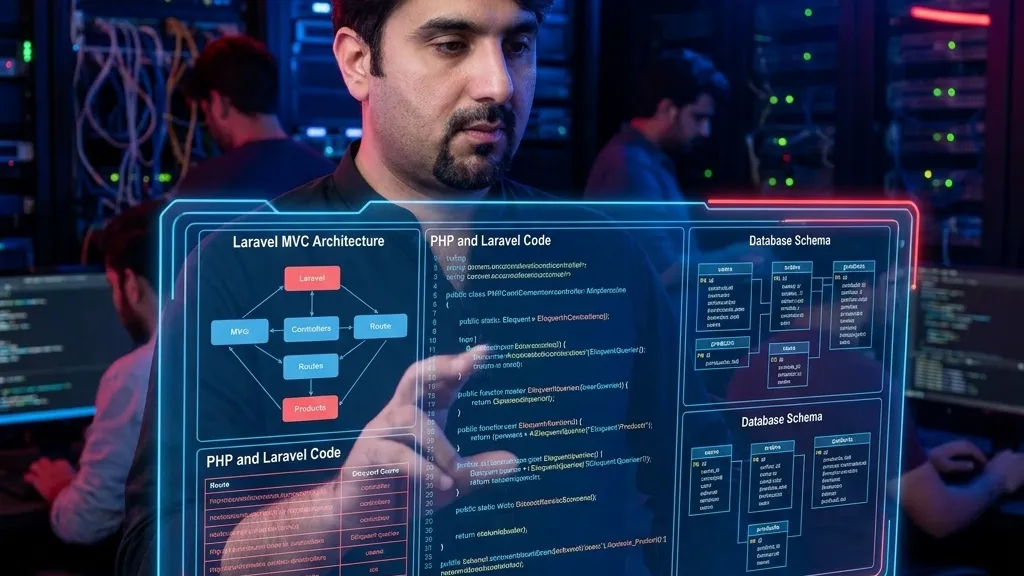
PHP & Laravel Enterprise Backend Architecture is an engineering discipline that structures, scales, and hardens mission-critical web applications using modern PHP 8.3+ and the Laravel framework. It unifies persistent in-memory runtimes (Octane), reactive administrative panels (Filament v3), distributed Redis queues (Horizon), and automated Pest testing to achieve sub-30ms response times at high concurrency.
Why I Architect with Laravel: Enterprise Performance Standards
Engineered for high-traffic endurance, persistent Octane memory runtimes, and extreme database efficiency.
Critical Laravel Architectural Challenges & Performance Traps
Four systemic infrastructure and code failure points that trigger slow response times, database deadlocks, and fragile deployments.
Unindexed Queries & N+1 Eloquent Explosions
Relying on default Eloquent dynamic properties without eager loading triggers hundreds of redundant queries per web request. I enforce strict eager loading, query profiling with Laravel Pulse, and compound composite database indexing.
Blocking Synchronous Request Workflows
Executing PDF generation, email notifications, and third-party webhook dispatch synchronously inside HTTP controllers stalls web worker pools. I decouple all non-essential logic into distributed Redis queues managed by Laravel Horizon.
Per-Request Bootstrapping Overhead
Traditional PHP-FPM boots the entire framework, service providers, and configuration files for every incoming request. I implement Laravel Octane on FrankenPHP, keeping worker memory hot to cut latency down to sub-30ms.
Monolithic Technical Debt & Untested Legacy Code
Bloated controllers and fat Eloquent models create brittle codebases where minor modifications trigger unexpected regressions. I introduce domain Action classes and establish automated Pest test suites with 90%+ code coverage.
Engineered Architecture: Production Topology & Security Perimeter
Technical Blueprint
Modern Engineering Craftsmanship Over Outdated PHP Stereotypes
Modern PHP 8.3+ and Laravel have evolved far beyond the procedural scripts of the past. With strict type systems, JIT compilation, asynchronous queue workers, and Octane runtimes, Laravel is a powerhouse for enterprise SaaS.
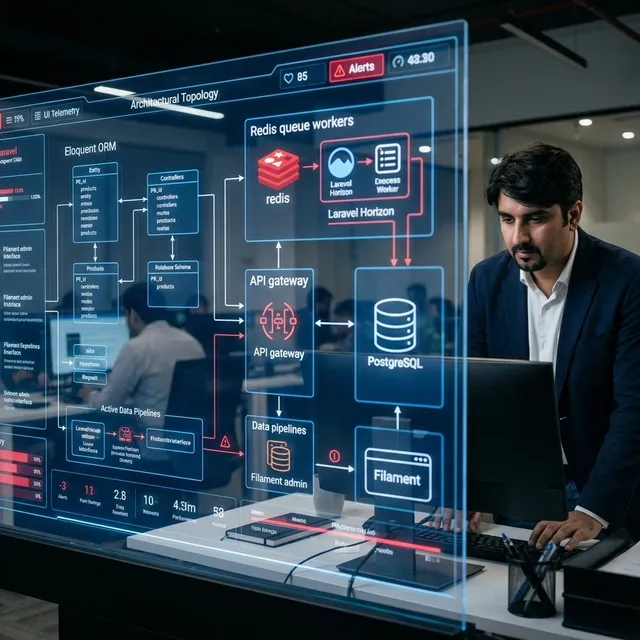
# Production Traffic & Service Execution Flow
[Client Request / Mobile App] → (Cloud Load Balancer / SSL Edge)
→ [Laravel Octane Runtime: FrankenPHP / Swoole Worker Pool]
• Auth & Validation: Sanctum / Passport OAuth2 & FormRequest DTOs
• Domain Layer: Single-Purpose Action Classes & Policies
• Heavy Tasks Dispatched → [Redis Cluster & Laravel Horizon]
• Priority Queue: Webhooks, Emails, Data Export Workers
• Data Tier: Optimized PostgreSQL / MySQL with Connection Pooling
→ [Observability]: Laravel Pulse Telemetry & Sentry Error Tracking
Persistent Memory Octane Workers
Laravel Octane boots the framework once into worker RAM via FrankenPHP or Swoole, enabling instant request handling and high-concurrency websocket management.
Decoupled Priority Queue Clusters
Redis-backed queues partitioned by workload urgency (critical webhooks, customer notifications, batch exports) with automated balancing via Laravel Horizon.
Domain Action Architecture
Single-responsibility Action classes encapsulate core business logic, decoupled from controllers and reusable across web endpoints, CLI commands, and scheduled jobs.
Automated Pest CI/CD Pipeline
GitHub Actions workflows executing Pest test suites, PHPStan static analysis at Level 8, Laravel Pint style enforcement, and zero-downtime rolling container releases.
Authoritative Architecture Standard
“Laravel provides an expressive, elegant syntax that values developer happiness without sacrificing application functionality. It offers powerful tools for dependency injection, an expressive database abstraction layer, queues and scheduled jobs, unit and integration testing, and more.”
Every backend application I architect adheres directly to Laravel's official architecture standards: explicit dependency injection via service containers, clean separation of concerns using domain actions, and rigorous testing with Pest PHP.
Backend Operating Model: Ad-Hoc PHP vs Engineered Architecture
Comparing unstructured procedural PHP development against modern, Octane-powered Laravel engineering.
| Architectural Dimension | Engineered Laravel Architecture (iGoher Standard) | Unmanaged Ad-Hoc PHP Development | Generic Script Framework Stack |
|---|---|---|---|
| Concurrency & Runtime | Laravel Octane on FrankenPHP/Swoole; persistent memory workers and sub-30ms execution. | Traditional PHP-FPM booting the entire framework per request with high CPU overhead. | Basic CGI script execution with poor connection recycling and severe latency spikes. |
| Admin & Backoffice Tooling | Filament v3 reactive TALL-stack panels delivered in hours with built-in RBAC and audit logs. | Handcrafted HTML/jQuery dashboards that require ongoing maintenance and lack security. | Rigid third-party SaaS admin tools with expensive per-seat pricing and vendor lock-in. |
| Background Job Orchestration | Redis queue clusters managed by Laravel Horizon with live metrics and automated retries. | Synchronous controller execution blocking web users until emails and exports finish. | Ad-hoc cron bash scripts with no concurrency management or dead-letter queuing. |
| Database Optimization & ORM | Strict eager loading, query indexing, connection pooling, and Redis model caching. | Uncontrolled Eloquent queries triggering catastrophic N+1 database locks. | Raw SQL queries scattered across presentation files with high vulnerability risk. |
| Automated Testing & Quality | 90%+ Pest integration test coverage, PHPStan Level 8 analysis, and Pint code styling. | Zero automated testing; code changes verified manually by clicking in the browser. | Sparse unit tests with broken fixtures and missing coverage for critical edge cases. |
| Deployment & Containerization | Hardened Docker images deployed to AWS ECS / Cloud Run with zero-downtime cutover. | Direct FTP/SSH file uploads to live production servers during active business hours. | Manual zip archive extractions with long maintenance windows and downtime. |
Implementation Lifecycle
Structured 4-Phase Laravel Backend Delivery Process
A predictable, phased delivery roadmap transforming complex business requirements into high-concurrency, enterprise-grade Laravel architectures.
- Phase 01
Discovery & Profiling
Analyze entity models, API contracts, slow query bottlenecks with Laravel Pulse, and third-party integrations to establish architecture baselines.
Duration: Week 1
- Phase 02
Domain Actions & Schemas
Author modular Action classes, define compound database indexes, implement Sanctum/Passport authentication, and construct FormRequest DTOs.
Duration: Weeks 2–3
- Phase 03
Filament & Queue Engines
Construct reactive Filament v3 backoffice suites, configure Redis Horizon queue partitions, and optimize Octane persistent memory runtimes.
Duration: Weeks 4–5
- Phase 04
Pest CI/CD & Release
Validate 90%+ Pest test coverage, run PHPStan Level 8 static checks, deploy containerized workloads, and establish real-time Sentry telemetry.
Duration: Week 6
Core Laravel Architectural Modules I Deliver
Engineered components built for enterprise scalability, rapid feature delivery, and long-term maintainability.
High-Throughput REST & GraphQL APIs
API architectures built with standard JSON:API specifications, GraphQL schemas via Lighthouse, and versioned routes capable of handling thousands of requests per second.
Multi-Tenant SaaS Architectures
Scalable multi-tenant databases with strict tenant data isolation (single database schema or multi-database partitioning), custom domain routing, and automated tenant provisioning.
Filament Admin & Backoffice Portals
Enterprise internal operations portals with granular role-based permissions, custom dashboard widgets, CSV/Excel export engines, and deep Eloquent relation managers.
Laravel Octane Server Infrastructure
High-performance production deployments using FrankenPHP or Swoole, eliminating per-request boots and handling massive websocket and concurrent user loads efficiently.
Event-Driven Background Processing
Robust background job architectures managed via Laravel Horizon, incorporating exponential backoff retries, Redis clustering, and real-time operational telemetry.
Legacy PHP & Monolith Refactoring
Modernizing monolithic or procedural PHP codebases using the Strangler Fig pattern, wrapping legacy endpoints in Pest tests before extracting clean domain actions.
Zero-Trust Authentication & IAM
Granular policy gates, Sanctum token authentication, Passport OAuth2 servers, and two-factor authentication protecting enterprise API endpoints.
Eloquent Indexing & Query Profiling
Eliminating N+1 queries, authoring complex migrations, configuring read/write database connection replicas, and instrumenting query telemetry via Laravel Pulse.
Automated Pest & Static Analysis Suites
Comprehensive test automation using Pest PHP, PHPStan static analysis at Level 8, Laravel Pint style formatting, and automated GitHub Actions CI/CD.
PHP & Laravel Production Stack Architecture Matrix
A comprehensive overview of the technological layers and components engineered in every enterprise Laravel deployment.
Framework & Runtimes
PHP 8.3+, Laravel 11, Laravel Octane, FrankenPHP, Swoole, and Composer dependency management.
Databases & Caching
PostgreSQL, MySQL, Redis Enterprise, Laravel Horizon, Eloquent ORM, and database connection pooling.
APIs & Authentication
Laravel Sanctum, Passport OAuth2, GraphQL Lighthouse, JSON:API resources, and FormRequest DTOs.
Backoffice & Admin
Filament v3, Livewire 3, Alpine.js, Tailwind CSS, role-based access control (RBAC), and export engines.
Quality & Testing
Pest PHP test framework, PHPStan static analysis (Level 8), Laravel Pint, and Sentry error monitoring.
DevOps & Deployment
Docker containerization, Google Cloud Run, AWS ECS Fargate, GitHub Actions CI/CD, and Terraform.
Architectural Glossary
Core Technical Definitions & Concepts
Authoritative definitions of fundamental Laravel mechanisms, concurrency parameters, and operational terms.
- Laravel Octane
- Laravel Octane is defined as a high-performance application server integration (using FrankenPHP or Swoole) that boots Laravel once in memory and keeps worker processes hot, eliminating traditional per-request framework bootstrapping overhead.
- Filament Admin Panel
- A Filament Admin Panel is defined as an extensible, TALL-stack backoffice software layer inside Laravel providing role-based access control, CRUD resource interfaces, dashboard metrics, and automated form processing.
- Laravel Horizon
- Laravel Horizon is defined as a queue management and monitoring dashboard for Redis queues, providing real-time metrics on job throughput, runtime execution, wait times, and automated worker balance.
- N+1 Query Bottleneck
- The N+1 Query Bottleneck is defined as an object-relational mapping (ORM) anti-pattern where an application executes 1 initial query to retrieve a dataset followed by N additional individual queries to fetch related entities, multiplying database load exponentially.
- Strangler Fig Pattern
- The Strangler Fig Pattern is defined as a software migration strategy where legacy system features are incrementally replaced by new microservices or refactored classes until the old architecture is completely deprecated without cutover downtime.
- Pest PHP
- Pest PHP is defined as a modern, expressive PHP testing framework focused on simplicity and developer experience, running unit, feature, and architecture tests with concise syntax and rich terminal reporting.
Complementary Technologies & Service Ecosystem
Explore related backend, cloud, and database technologies across my technical architecture portfolio.
Laravel Backend Development Services
Comprehensive enterprise backend engineering, high-concurrency API design, and SaaS architectures.
Google Cloud (GCP) Architecture
Deploying containerized Laravel Octane applications on Cloud Run with Cloud SQL and Memorystore Redis.
Amazon AWS Architecture
Scalable container hosting on ECS Fargate, Aurora PostgreSQL/MySQL clusters, and SQS queue processing.
Relational & Distributed Databases
High-availability schema design, query optimization, PostgreSQL, MySQL, and distributed data management.
DevOps & Automated CI/CD
Automated GitHub Actions workflows, Terraform infrastructure, zero-downtime releases, and container pipelines.
Full-Stack Web Development
Headless web applications pairing Laravel API backends with fast Astro, React, and Vue frontends.
Authoritative References & Documentation
- Laravel Official Documentation — Complete framework architecture and component specifications.
- Filament Documentation — Official administrative panel and form builder specifications.
- Pest PHP Documentation — Testing framework documentation and architecture testing guides.
- Laravel Octane Documentation — High-performance persistent application server guide.
Architectural Guidance
Frequently Asked Questions on Laravel Backend Architecture
Direct answers to critical engineering, concurrency, and refactoring questions from tech leads and decision-makers.
How do I scale Laravel past 10,000 concurrent users without database locks?
I implement Laravel Octane powered by FrankenPHP or Swoole to keep application boots persistent in worker memory, cutting request latency down to sub-30ms. Heavy business tasks (emails, webhooks, analytics, PDF generation) are decoupled through Redis worker clusters managed by Laravel Horizon. Database reads and writes are separated with connection pooling, strict query indexing, and caching to eliminate N+1 bottlenecks.
Why do I build backoffice systems with Filament v3 instead of custom dashboards?
Filament v3 delivers a production-grade, highly secure administrative interface built directly on the TALL stack (Tailwind, Alpine, Laravel, Livewire), saving hundreds of engineering hours without sacrificing flexibility. It includes built-in role-based access control, complex relation managers, export engines, and audit logging out of the box, ensuring rapid delivery and effortless long-term maintainability.
How do I architect secure REST and GraphQL APIs for client applications?
All API endpoints enforce zero-trust security through Laravel Sanctum or Passport OAuth2 authentication, granular policy gates, and strict FormRequest validation with sanitized Data Transfer Objects (DTOs). I configure automated rate-limiting per API key, CORS origin whitelisting, database query parameterization, and automated OWASP vulnerability scans in CI/CD.
How do I refactor legacy PHP codebases into modern Laravel architectures?
I use the Strangler Fig pattern to refactor legacy codebases incrementally. Endpoints are wrapped in automated Pest PHP integration tests before moving business logic into modern Action and Domain Service classes. This guarantees zero production downtime, prevents regression bugs, and preserves existing data integrity throughout migration.
How does Laravel integrate with cloud platforms and frontend frameworks?
Laravel functions as the robust API and queue backbone for my full-stack web applications built in Astro, React, and Vue, as well as mobile backends for Flutter apps. I deploy Laravel backends onto AWS ECS/Fargate, Google Cloud Run, or custom Docker environments with automated GitHub Actions CI/CD.
How do I prevent memory leaks when running Laravel Octane in production?
Because Laravel Octane maintains application state across requests in persistent memory, I design service classes to be strictly stateless. I avoid binding mutable singletons or appending unbound data to static arrays, register proper Octane request listeners to flush contextual data, and set conservative worker request limits so processes recycle safely before memory accumulates.
How do I structure multi-tenant databases for enterprise SaaS applications?
Depending on compliance and scale, I architect either single-database tenant scoping using global Eloquent query scopes and tenant identification middleware, or multi-database tenant partitioning where each corporate customer receives an isolated database connection. Both approaches enforce automated tenant context switching and encrypted tenant storage.
What does a Laravel architecture consultation engagement include?
Engagements include codebase audits and slow query profiling with Laravel Pulse, domain model refactoring, Filament admin portal construction, Horizon queue calibration, automated Pest testing integration, and containerized deployment to Google Cloud or AWS with zero-downtime GitHub Actions workflows.
Let’s Connect
Ready to Engineer a Scalable Laravel Backend?
Schedule a direct technical consultation with an enterprise full-stack architect. Discuss your application requirements, database optimization, or SaaS delivery with clear milestones.