

Enterprise Engineering Service
Laravel Backend Development Services for High-Concurrency Systems
High-Throughput APIs, Horizon Queues & Resilient Database Architecture.We engineer mission-critical Laravel backends, multi-tenant SaaS platforms, and high-throughput REST/GraphQL APIs built to handle demanding concurrent workloads. Eliminate monolithic controller bloat, N+1 query latency, and deployment vulnerabilities with enterprise-grade PHP engineering.
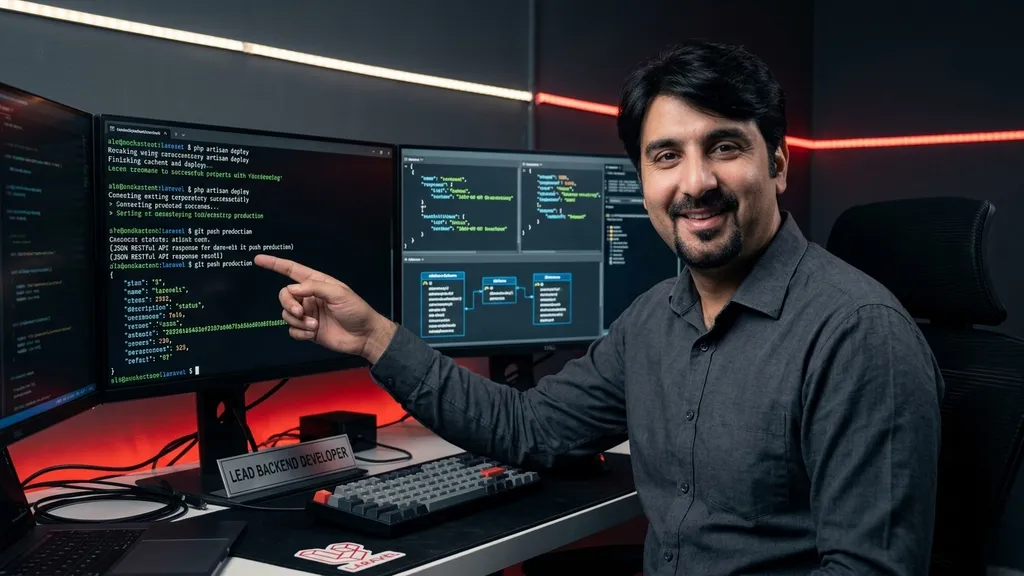
What is Enterprise Laravel Backend Architecture?
Enterprise Laravel Backend Development is an architectural engineering discipline that designs, optimizes, and maintains server-side web applications and API platforms using the modern Laravel ecosystem. Unlike basic PHP development, enterprise Laravel backends enforce clean separation of concerns through Domain-Driven Action patterns, strong Data Transfer Objects (DTOs), and asynchronous job queues. We implement connection-pooled databases, composite indexing to eliminate N+1 queries, and persistent in-memory execution via Laravel Octane to achieve sub-50ms API latencies under high concurrency. Backends are delivered with complete automated test coverage, native Filament v5 administrative control centers, and 100% intellectual property transfer to your team.
Engineering Standards That Guarantee Backend Reliability
Engineered for mission-critical operations, zero-downtime releases, and high-traffic endurance.
The Architecture Challenge
Why Outdated Laravel Backends Create Bottlenecks Under Scale
When applications grow without strict domain boundaries, controllers bloat, database queries multiply, and minor deployments become high-risk events.
Controller Bloat & Mixed Business Rules
When controllers accumulate thousands of lines mixing database queries, validation, and email dispatches, small feature additions become prone to cascading regression bugs.
Database Contention & N+1 Query Loops
Unmonitored Eloquent relationships spawn hidden N+1 query loops that spike database CPU, exhaust connection pools, and produce 504 gateway timeouts under peak traffic.
Insecure Auth Gates & Unsanitized Endpoints
Ad-hoc controllers lacking FormRequest validation and strict policy gates risk privilege escalation and unauthorized data exposure across REST and GraphQL endpoints.
Synchronous Workload Blocking
Processing time-consuming tasks like PDF generation, file imports, or third-party webhooks inside web request workers blocks server threads and degrades user responsiveness.
Engineered for High Concurrency and Long-Term Maintainability
We engineer scalable, maintainable Laravel backend systems designed to withstand demanding enterprise workloads. By enforcing strict domain separation, optimizing query lifecycles, and automating infrastructure pipelines on Amazon AWS and PostgreSQL / MySQL, your platform delivers consistent execution speeds and predictable cloud infrastructure expenses.
Discover how our backend architectures power client frontends in Web Development, native client apps in Mobile Application Development, and strategic cloud oversight in IT Consultancy.
Domain Actions & Single-Responsibility Classes
Decoupling controllers into dedicated Action classes, Data Transfer Objects (DTOs), and domain services. Your business logic stays clean, isolated, and straightforward to test.
Asynchronous Queues with Laravel Horizon
Partitioning heavy processing into Redis-powered background queues with automated retry policies, dead-letter alerts, and supervisor monitoring to keep user-facing APIs fast.
Database Indexing & Read/Write Splitting
Hardening data layers with composite indexing, eager loading strategies, connection pooling, and read-replica distribution capable of multi-million row scale.
Filament v5 Native Operations Dashboard
Building customized, clean administrative interfaces and SaaS multi-tenant portals using the TALL stack with granular role-based permissions and instant performance.

Incoming API Request → Laravel Octane (FrankenPHP) → FormRequest / DTO Validation → Domain Action → Primary / Read-Replica DB & Redis Cache → Asynchronous Job Queue (Laravel Horizon).
“In high-concurrency Laravel architecture, performance is not an afterthought added with caching layers—it is engineered directly into database schema indexing, domain action isolation, and asynchronous queue topology from day one.”— Goher K, Principal Solutions Architect at iGoher
Architectural Rigor
Typical Agency Approach vs. iGoher Laravel Architecture
See the practical technical difference between standard outsourced PHP code and hardened enterprise Laravel engineering.
| Architectural Vector | Typical Agency / FreelancerAd-hoc PHP implementation | iGoher ArchitectureEnterprise-grade LaravelRecommended |
|---|---|---|
| Architectural PatternLayering and code separation standard | Fat controllers, mixed business logic, procedural code | Domain-Driven Design, Actions, DTOs, and clean Service layers |
| Database & Query PerformanceQuery optimization and concurrency protection | Unindexed tables, hidden N+1 queries, high query latency | Strict schema indexing, read-replicas, and optimized query budgets |
| Asynchronous Queue InfrastructureBackground workload and worker management | Synchronous blocking operations and unmonitored background jobs | Redis queue clusters via Laravel Horizon with automated retries |
| Administrative Operations PanelBackoffice management and internal tooling | Clunky custom CRUD templates or third-party plugin bloat | Native Filament v5 panel with granular RBAC and audit logging |
| Automated Testing & Code QualityTest coverage and continuous integration | Minimal automated tests with manual verification in production | Comprehensive Pest test suites and static analysis via PHPStan Level 8 |
| API Security & AuthorizationAuthentication and access control protocols | Ad-hoc controllers, loose validation, and exposed API endpoints | Sanctum/Passport OAuth2, FormRequest DTOs, and OWASP-conscious design |
| Code Ownership & Framework ModernityUpgradability and vendor independence | Outdated versions, vendor lock-in, and undocumented legacy hacks | Laravel 11+ standards, automated migrations, and 100% IP transfer |
Structured Delivery
The 4-Phase Laravel Engineering Process
Every backend engineering engagement follows a disciplined four-phase sequence to ensure architectural clarity and milestone predictability.
- 1
Phase 1: Architecture Blueprinting & Schema Design
We evaluate domain boundaries, plan entity relationships, design normalized database schemas, and draft OpenAPI contracts. We resolve architectural decisions before writing production code.
- 2
Phase 2: Core Domain Sprints & API Development
We develop single-responsibility Action classes, API controllers, and database migrations. Background workers are configured with Laravel Horizon, and custom Filament v5 backoffices are built in parallel.
- 3
Phase 3: Performance Profiling & Security Audits
We profile query efficiency using Laravel Pulse and Telescope to eliminate N+1 queries. We run automated Pest test suites, execute PHPStan Level 8 analysis, and audit endpoint authorization gates.
- 4
Phase 4: Zero-Downtime Deployment & Complete Handover
We configure automated CI/CD deployment pipelines on AWS or dedicated cloud environments with zero-downtime releases. We conduct knowledge transfer sessions and transfer 100% administrative credentials and Git repositories to your team.
Scope of Work
Functional Engineering Modules & Deliverables
Every module is delivered with production-ready source code, automated test suites, architectural documentation, and zero technical debt.
Module 1: Architecture Blueprint & Domain Modeling
Deliverable: Domain-driven entity relationship design, database schema migration blueprints, and service contracts.
Tools: C4 Model, DrawSQL, DBML, Laravel Migrations.
Handover: Complete System Architecture Document (SAD) and Entity-Relationship Diagrams (ERD).
Module 2: High-Throughput REST & GraphQL API Gateway
Deliverable: Versioned, stateless API endpoints with Sanctum/Passport authentication, rate-limiting, and response caching.
Tools: Laravel 11, Sanctum, OpenAPI 3.1, Postman.
Handover: Documented API gateway, Postman collection, and interactive Swagger documentation.
Module 3: Filament v5 Admin Panel & Ops Dashboard
Deliverable: Custom administrative control panel with role-based access control (RBAC), data export pipelines, and metrics.
Tools: Filament v5, Livewire 3, Tailwind CSS, Alpine.js.
Handover: Production admin panel with user permission matrix and administrator training guide.
Module 4: Asynchronous Queues & Event Pipelines
Deliverable: Redis-powered job queue infrastructure with priority routing, Horizon telemetry, and webhook workers.
Tools: Laravel Horizon, Redis, Supervisor, Webhook Handlers.
Handover: Queue architecture configuration, retry strategy runbooks, and telemetry dashboard.
Module 5: Database Optimization & Concurrency Scaling
Deliverable: Zero N+1 query guarantee, composite index implementation, and database read-replica configuration.
Tools: Laravel Pulse, Telescope, PostgreSQL, Redis.
Handover: Database optimization audit report and query performance benchmark sheet.
Module 6: CI/CD Pipelines & Automated Testing
Deliverable: Multi-environment deployment pipeline with automated Pest test suites, static analysis, and zero downtime.
Tools: GitHub Actions, Pest PHP, PHPStan, Docker, Forge.
Handover: Production CI/CD workflow files, test suite code repository, and disaster recovery runbooks.
Enterprise Technology Matrix
Production-Grade Technologies & Standards
Carefully selected for execution performance, security compliance, and long-term ecosystem stability.
Core Runtime & Framework
PHP 8.3+, Laravel 11+, Laravel Octane (FrankenPHP / Swoole), Composer.
APIs & Authentication
Laravel Sanctum, Passport OAuth2, GraphQL (Lighthouse), OpenAPI 3.1.
Data & High-Speed Caching
PostgreSQL 16+, MySQL 8+, Redis 7+, Meilisearch, Laravel Scout.
Admin & Internal Tools
Filament v5, Livewire 3, Alpine.js, Tailwind CSS, Laravel Nova.
Testing & Code Quality
Pest PHP, PHPUnit, PHPStan (Level 8), Laravel Pint, GitHub Actions.
Monitoring & Infrastructure
Laravel Horizon, Pulse, Telescope, Sentry, Docker, AWS / Forge.
Core Architecture Glossary
Technical Definitions & System Concepts
Clear definitions of enterprise Laravel mechanisms, concurrency parameters, and operational terms.
- Laravel Backend Architecture
- The structural organization of server-side PHP components, domain services, database schemas, and REST/GraphQL APIs utilizing the Laravel framework to securely execute business logic, manage state, and process client transactions.
- Concurrent User Capacity (CCU)
- The maximum number of simultaneous active user sessions, connections, or API consumers an application backend can process in parallel without exceeding established latency budgets or exhausting system resources.
- N+1 Query Bottleneck
- An object-relational mapping (ORM) pattern where an application executes 1 initial query to retrieve a dataset followed by N additional queries to fetch related entities, multiplying database load under scale.
- Filament Admin Panel
- An extensible, TALL-stack backoffice software layer inside Laravel providing role-based access control, CRUD resource interfaces, dashboard metrics, and automated form processing.
- Laravel Octane
- A high-performance application server integration (using FrankenPHP or Swoole) that boots Laravel once in memory and keeps worker processes hot, eliminating traditional per-request framework bootstrapping overhead.
- Domain-Driven Action Pattern
- A software design pattern where discrete business operations are encapsulated inside dedicated, single-purpose PHP classes rather than bloated controller methods, maximizing testability and code reuse.
Complementary Services & Architecture Ecosystem
Explore related enterprise development services and high-performance technology stacks.
Full-Stack Web Development
Modern reactive web frontends, high-performance portal architectures, and API-first client integrations.
Enterprise IT Consultancy
Cloud architecture design, multi-AZ deployment planning, security audits, and legacy system refactoring.
Divi 5 Theme Expert Services
Pair headless Laravel backends with modern Divi 5 frontend sites via secure REST and GraphQL endpoints.
Cross-Platform Mobile Apps
Flutter iOS and Android applications powered by high-concurrency Laravel REST and GraphQL APIs.
PHP / Laravel Technology Stack
Deep architectural overview of my core Laravel stack, Eloquent ORM tuning, and Octane runtime deployment.
Relational Database Engineering
High-availability schema design, query plan profiling, and connection pooling across PostgreSQL and MySQL.
Amazon AWS Cloud Infrastructure
Containerized ECS Fargate clusters, Aurora PostgreSQL multi-AZ databases, and automated Terraform pipelines.
Direct Technical Answers
Frequently Asked Questions About Laravel Backend Architecture
Direct answers to technical, architectural, and project delivery questions for engineering leaders and decision-makers.
How do you handle legacy Laravel refactoring without interrupting live users?
We refactor legacy Laravel applications incrementally using the Strangler Fig pattern, wrapping legacy endpoints in comprehensive Pest/PHPUnit integration tests before moving business logic into modern Action and Domain Service classes. Critical database queries and N+1 bottlenecks are resolved first using automated profiling tools like Laravel Pulse and Telescope. This ensures zero production downtime and preserves data integrity throughout the transition.
How do you scale Laravel applications to handle over 10,000 concurrent users?
Scaling Laravel past 10,000 concurrent requests requires decoupling synchronous operations through Redis-backed queue clusters managed by Laravel Horizon, along with database read/write connection pooling. We deploy Laravel Octane powered by FrankenPHP or Swoole to keep application boots persistent in memory, reducing request latency from 150ms down to sub-30ms execution times.
Why choose Filament v5 instead of building a custom admin dashboard from scratch?
Filament v5 delivers a production-grade, highly secure administrative interface built directly on the TALL stack (Tailwind, Alpine, Laravel, Livewire), saving hundreds of engineering hours without sacrificing flexibility. It includes built-in role-based access control, complex relation managers, export engines, and audit logging out of the box, ensuring rapid delivery and effortless long-term maintainability.
What caching and queue architectures do you implement for heavy background workloads?
We implement multi-tiered Redis caching for frequently queried Eloquent models alongside dedicated Redis worker queues partitioned by priority (e.g., high, default, webhooks, exports). Failed jobs are guarded with exponential backoff retries, dead-letter notifications, and real-time throughput monitoring via Laravel Horizon dashboards to prevent database resource exhaustion.
How do you secure Laravel REST and GraphQL APIs against security vulnerabilities?
All API endpoints enforce zero-trust architecture through Laravel Sanctum or Passport OAuth2 authentication, granular policy gates, and strict FormRequest validation with sanitized DTOs. We configure automated rate-limiting per API key, CORS origin whitelisting, database query parameterization, and automated OWASP vulnerability scans in our CI/CD pipelines.
How is automated testing structured for custom Laravel systems?
Every Laravel application is developed with a comprehensive test suite using Pest PHP, covering unit business logic, feature request/response lifecycles, and database factory transactions. Pull requests trigger automated GitHub Actions pipelines that run static analysis via PHPStan at level 8+, code styling via Laravel Pint, and regression test suites before staging merges.
Who owns the intellectual property, repositories, and server infrastructure?
You maintain 100% intellectual property ownership of all source code, database migrations, configuration scripts, and documentation developed for your application. Upon milestone completion, all Git repositories, cloud deployment credentials, and third-party service tokens are transferred directly to your organization with zero proprietary licensing lock-in.
What are your SLAs, milestone deliverables, and post-launch maintenance terms?
Engagements operate on structured two-week agile sprint cycles with transparent backlog tracking, automated staging previews, and weekly architecture demonstrations. Every production release is backed by a 30-day comprehensive warranty covering critical bug resolutions, performance monitoring calibration, and dedicated SLA support response windows.
Let’s Connect
Ready to Engineer a Scalable Laravel Backend?
Schedule a direct technical consultation with an enterprise solutions architect. Share your requirements below to discuss system specifications, queue architectures, and delivery timelines.