

Enterprise Cloud Infrastructure & Database Engineering
Oracle Cloud OCI Architecture Consulting & Enterprise Cloud Systems
High-performance cloud environments, Autonomous Database clusters, and non-blocking network fabrics engineered for enterprise mission-critical workloads with superior price-performance.

What Is Oracle Cloud (OCI) Architecture Consulting?
Oracle Cloud Infrastructure (OCI) Architecture Consulting is an enterprise systems discipline that plans, provisions, and secures high-performance cloud environments on Oracle's Gen 2 network fabric. It unites self-driving Autonomous Databases, dedicated Bare Metal shapes, fault-domain clustering, and declarative Terraform IaC to achieve superior throughput at 30% to 50% lower total cost of ownership.
Production-Validated OCI Performance & Reliability
Engineered for high IOPS throughput, zero-downtime maintenance, and aggressive total cost reduction.
Critical OCI Architectural Challenges & Cost/Security Traps
Four systemic infrastructure failure points that trigger security breaches, operational outages, and budget overruns if unaddressed.
Unchecked Compartment Sprawl & Permissive IAM
Failing to structure OCI Compartments with strict policy inheritance leads to privilege escalation and public resource exposure. I establish hierarchical compartments with automated Security Zones that block public IP bindings.
Over-Provisioned Bare Metal & Exadata Shapes
Deploying maximum-capacity Bare Metal or Exadata instances for non-production environments inflates monthly cloud budgets needlessly. I implement autoscaling Autonomous Databases and flexible VM shapes to match exact demands.
Single-Fault-Domain Workload Placement
Placing all application compute instances in a single Fault Domain leaves systems vulnerable to top-of-rack switch or power failure. I distribute workloads across all three Fault Domains behind private Flexible Load Balancers.
Manual Console ClickOps Drift
Modifying VCN routes, security lists, and database options manually creates undocumented dependencies and broken disaster recovery procedures. I enforce 100% Terraform Infrastructure as Code via OCI Resource Manager.
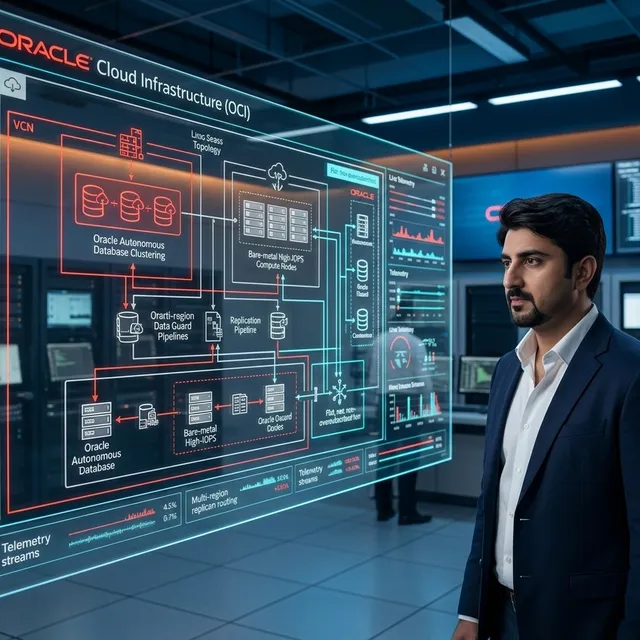
Engineered Architecture: Production Topology & Security Perimeter
Technical Blueprint
Enterprise Relational Muscle with Superior Cloud Economics
When enterprise applications require extreme database throughput and predictable cloud spending, Oracle Cloud Infrastructure outperforms generic hyperscalers. In my architecture practice, OCI is frequently paired with distributed database designs and multi-cloud governance.
# Production Traffic & Security Ingress Flow
[Client Ingress / Multi-Cloud FastConnect] → (OCI Flexible Load Balancer & WAF)
→ [Private Virtual Cloud Network (VCN) with Dynamic Routing Gateway]
• Tier 1: Application Compute across Fault Domains (FD1, FD2, FD3)
• Tier 2: Oracle Autonomous Database / Exadata Database Service
• Tier 3: Block Storage with Automated KMS Hardware Key Encryption
→ [Data Guard Replication] → Remote OCI Disaster Recovery Region
→ [Security Perimeter]: Maximum Security Zones & OCI Vault
Hierarchical Compartment Isolation
Structuring governance through OCI Compartments with granular IAM policies, ensuring strict separation of concerns between production, staging, and audit domains.
Private Virtual Cloud Networks (VCN)
Database tiers strictly housed in private subnets, accessible only through Bastion Service endpoints and Service Gateways without exposing public IP addresses.
Automated Data Guard Disaster Recovery
Synchronous and asynchronous block-level replication across geographically separated OCI regions guarantees zero data loss (RPO=0) during catastrophic events.
FastConnect Multi-Cloud Integration
Sub-2ms direct interconnect fabrics linking OCI databases to application tiers running in Amazon AWS or Microsoft Azure with zero internet exposure.
Authoritative Architecture Framework
“The Oracle Architecture Center provides reference architectures, solution playbooks, and best practices to help organizations design, deploy, and operate secure, highly available, and cost-optimized workloads on Oracle Cloud Infrastructure.”
Every architecture engagement I lead directly aligns with Oracle's official Architecture Center standards: rigorous compartment isolation, non-blocking network topology, and automated disaster recovery using Oracle Data Guard.
Enterprise Operating Model: Fragile ClickOps vs Engineered Cloud
Comparing ad-hoc console administration against automated, Terraform-governed Oracle Cloud engineering.
| Architectural Dimension | Engineered OCI Architecture (iGoher Standard) | Unmanaged ClickOps Administration | Generic Shared Multi-Tenant Cloud |
|---|---|---|---|
| Provisioning & State Management | 100% Terraform/OpenTofu IaC modules with state locking in OCI Object Storage. | Manual OCI web console button-clicking; undocumented setups and configuration drift. | Proprietary web panels with zero Git tracking or automated deployment pipelines. |
| Database High Availability & Failover | Autonomous Database with automated self-patching and cross-region Data Guard failover. | Single-instance database shapes without automated replication or point-in-time recovery. | Shared MySQL instances with nightly dump scripts and extensive data loss windows. |
| Hardware & Compute Performance | Dedicated Bare Metal compute shapes with NVMe arrays and zero hypervisor overhead. | Standard virtual machines subject to hypervisor noisy-neighbor performance drops. | Oversubscribed VPS slices with volatile CPU throttles and shared memory buses. |
| Security & Governance | OCI Security Zones, FIPS 140-2 Level 3 KMS encryption, and Bastion endpoints. | Public IP addresses attached directly to database instances and open security lists. | Shared root passwords and static API keys without access expiration policies. |
| Network Architecture & Latency | Flat Gen 2 non-oversubscribed network fabric with sub-2ms multi-cloud FastConnect. | Standard multi-hop network routing with unpredictable congestion latencies. | Public internet routing between services with high packet loss and jitter. |
| Bandwidth & Egress Costs | First 10 TB monthly outbound egress free; transparent predictable low rate thereafter. | Uncontrolled outbound data transfer leading to unexpected four-figure billing spikes. | Opaque billing bundles with hidden network transfer fees and high exit penalties. |
Implementation Lifecycle
Structured 4-Phase OCI Cloud Engineering Delivery Process
A predictable, phased delivery roadmap transforming legacy infrastructure into automated, enterprise-grade Oracle Cloud Infrastructure topologies.
- Phase 01
Discovery & Workload Assessment
Examine database IOPS requirements, compute workloads, software licenses (BYOL), and multi-cloud connectivity needs to establish migration baselines.
Duration: Week 1
- Phase 02
Terraform IaC & Compartment Setup
Author modular Terraform modules establishing hierarchical Compartments, VCN routing, Security Zones, and private Subnets across Fault Domains.
Duration: Weeks 2–3
- Phase 03
Database & Compute Migration
Migrate transactional databases to Oracle Autonomous Database or Exadata, provision Bare Metal/VM compute, and configure Data Guard replication.
Duration: Weeks 4–5
- Phase 04
Production Cutover & FinOps
Shift production traffic through OCI Flexible Load Balancers, activate Cloud Guard threat monitoring, configure compartment quotas, and train engineering teams.
Duration: Week 6
Core OCI Services I Engineer for Client Workloads
Authoritative implementation across database, compute, networking, storage, and governance engines.
Oracle Autonomous Database
Self-driving, self-securing, and self-repairing database engines that dynamically scale compute and storage while executing real-time automated security patching without downtime.
Dedicated Bare Metal Compute
Uncompromising compute shapes with zero virtualization overhead, dedicated memory buses, and NVMe SSD arrays for extreme enterprise transactional performance.
Flat Non-Oversubscribed Fabric
OCI Gen 2 flat network fabric connects compute instances directly without hop congestion, providing predictable sub-millisecond latencies and high-bandwidth IOPS.
Multi-Cloud FastConnect Fabrics
Private high-speed interconnects linking OCI directly to Microsoft Azure and Amazon AWS, allowing hybrid application tiers to query OCI databases with sub-2ms latency.
Fault-Domain High Availability
Distributing clustered workloads across distinct hardware racks within Availability Domains prevents simultaneous hardware, power supply, or top-of-rack switch failures.
Oracle Data Guard Replication
Automated disaster recovery framework that synchronizes physical standby databases across geographically separated regions for zero data loss protection.
Flexible Load Balancers
Elastic Layer 4 and Layer 7 load balancers that dynamically adjust bandwidth from 10 Mbps to 8 Gbps without pre-warming, terminating client TLS securely.
OCI Maximum Security Zones
Automated security guardrails that enforce strict policies—preventing public IP exposure on databases, requiring customer-managed encryption keys, and isolating subnets.
Terraform & Resource Manager
Authoring 100% declarative infrastructure code using the official OCI Terraform Provider, managing state in encrypted object storage with team access auditing.
Oracle Cloud Production Stack Architecture Matrix
A comprehensive overview of the technological layers and components engineered in every enterprise OCI deployment.
Compute & Runtimes
OCI Bare Metal shapes, Flexible Virtual Machines, Container Engine for Kubernetes (OKE), and OCI Functions.
Databases & Storage
Autonomous Database (ATP/ADW), Exadata Database Service, OCI MySQL HeatWave, Block Volumes, and File Storage.
Networking & Multi-Cloud
Virtual Cloud Network (VCN), Dynamic Routing Gateway, OCI FastConnect, Flexible Load Balancers, and DNS.
Disaster Recovery
Oracle Data Guard, cross-region storage replication, GoldenGate real-time sync, and automated backup schedules.
Security & Identity
OCI Security Zones, Cloud Guard, OCI Vault (KMS), Identity and Access Management (IAM), and Web Application Firewall.
DevOps & FinOps
OCI Resource Manager (Terraform), OCI Monitoring, Logging Analytics, Budgets, and Compartment Quotas.
Architectural Glossary
Core Oracle Cloud Technical Definitions
Authoritative definitions of fundamental Oracle Cloud Infrastructure constructs, database engines, and networking primitives.
- Oracle Autonomous Database
- Oracle Autonomous Database is defined as a cloud-native, fully automated relational database service that leverages artificial intelligence to execute provisioning, tuning, scaling, backups, and security patching without administrator intervention.
- Fault Domain (FD)
- An OCI Fault Domain is defined as a grouping of hardware and infrastructure within an Availability Domain that shares no single point of failure (power, cooling, rack switch), protecting workloads against localized hardware outages.
- Virtual Cloud Network (VCN)
- An OCI VCN is defined as a software-defined, private networking environment provisioned in Oracle Cloud, encompassing IP CIDR blocks, subnets, route tables, internet gateways, and security lists.
- OCI Compartment
- An OCI Compartment is defined as a logical collection of related cloud resources (compute, databases, storage) used to isolate, control access through IAM policies, and measure cloud expenditures hierarchically.
- OCI FastConnect
- OCI FastConnect is defined as a dedicated, private network connection between on-premises data centers or third-party clouds and Oracle Cloud Infrastructure, bypassing the public internet for deterministic throughput.
- Oracle Data Guard
- Oracle Data Guard is defined as an enterprise high-availability and disaster recovery framework that creates, manages, and synchronizes one or more standby databases to protect against data corruption and datacenter failures.
Complementary Technologies & Service Ecosystem
Explore related cloud architectures, databases, and consulting practices across my technical portfolio.
Relational Database Architecture
Deep database schema design, ACID transactions, and query optimization in PostgreSQL and MySQL.
Amazon AWS Cloud Infrastructure
Multi-cloud elasticity, AWS EKS Kubernetes clusters, Aurora PostgreSQL, and serverless Lambda architectures.
Google Cloud (GCP) Architecture
GKE Autopilot, Cloud Run microservices, BigQuery analytics, and multi-cloud data warehousing.
DevOps & CI/CD Pipelines
Terraform infrastructure automation, automated GitHub Actions workflows, and zero-downtime releases.
Enterprise IT Consultancy Services
Strategic cloud architecture design, legacy migration blueprints, security audits, and infrastructure reviews.
Laravel Backend Architecture
High-concurrency API backends, queue architectures, and Filament admin systems integrated with enterprise databases.
Authoritative References & Documentation
- Oracle Cloud Infrastructure Documentation — OCI architecture, core services, and security specifications.
- Oracle Autonomous Database Overview — Machine-learning driven self-tuning database technology specifications.
- Oracle Data Guard Concepts — High-availability disaster recovery and real-time database replication guidelines.
- Terraform OCI Provider Documentation — Declarative Infrastructure as Code automation standards for Oracle Cloud.
OCI Guidance
Frequently Asked Questions on Oracle Cloud Infrastructure
Direct answers to critical questions regarding OCI migration, licensing, database performance, and multi-cloud integration.
Why choose Oracle Cloud Infrastructure (OCI) for enterprise workloads over AWS or GCP?
OCI delivers industry-leading price-performance for compute-intensive workloads, massive I/O operations, and Oracle Autonomous Database instances. With zero-cost intra-region networking, flat network topology with no resource oversubscription, and superior hardware isolation via dedicated Bare Metal shapes, OCI provides predictable performance at 30% to 50% lower compute and egress costs than competing hyperscalers.
How does Oracle Autonomous Database eliminate manual database administration?
Oracle Autonomous Database uses machine learning to automate provisioning, tuning, indexing, backup encryption, and security patching while running live without downtime. It dynamically scales compute cores and storage up or down based on query demands, ensuring peak transactional throughput for mission-critical ERP, CRM, and financial databases.
How do I architect high availability across OCI Regions and Fault Domains?
I architect enterprise systems using OCI Availability Domains (ADs) and Fault Domains (FDs). Fault Domains act as logical data centers within an AD, isolating workloads against power, network, and hardware rack failures. Paired with OCI Flexible Load Balancers and automated cross-region Data Guard replication, this architecture guarantees 99.99% operational uptime.
Can OCI integrate smoothly into a multi-cloud strategy alongside AWS or Azure?
Yes. OCI provides specialized low-latency multi-cloud interconnects—such as the Oracle Interconnect for Microsoft Azure and AWS Direct Connect integrations—offering sub-2ms network latency. This enables enterprise architectures where application logic runs on AWS or Azure while enterprise transactional data remains housed securely within OCI Exadata systems.
How do I manage and automate OCI resources via Infrastructure as Code (IaC)?
I automate OCI provisioning using the official OCI Terraform Provider and OCI Resource Manager. All Virtual Cloud Networks (VCNs), subnets, compute instances, security lists, and dynamic IAM groups are codified in version-controlled Git repositories, ensuring reproducible, audited enterprise infrastructure.
How does OCI eliminate network egress costs for data-intensive applications?
Unlike AWS or Google Cloud which charge steep egress fees starting at modest data thresholds, OCI provides the first 10 TB of outbound internet data transfer free every month per tenancy. Above 10 TB, OCI outbound bandwidth rates are a fraction of competitor prices, making it the ideal host for high-throughput media, data warehouses, and API backends.
How do I protect client OCI environments against security breaches?
I configure OCI Security Zones with automated security recipes that prevent configuration drift—such as public IP attachment to database instances, unencrypted block volumes, or public bucket access. Database tiers strictly operate inside private subnets, accessible only through Bastion Service endpoints and Service Gateways.
What does an enterprise OCI architecture engagement typically include?
Engagements include infrastructure discovery and Well-Architected review, compartment structure planning, declarative Terraform code authoring, Autonomous Database migration with minimal downtime, multi-cloud interconnect configuration, observability calibration (OCI Monitoring & Logging), and handover documentation with team training.
Let’s Connect
Ready to Architect Your Enterprise Infrastructure on OCI?
Schedule a direct technical consultation with an enterprise cloud architect. Discuss your Oracle database migration, bare-metal high-throughput compute, or multi-cloud interconnect with concrete engineering milestones.