

Global Edge Infrastructure & Cybersecurity
Cloudflare Edge Computing Architecture & Global CDN Security Systems
Ultra-low latency serverless edge execution, automated enterprise DDoS defense, Zero Trust private application access, and global CDN acceleration spanning 300+ edge data centers worldwide.

What Is Enterprise Cloudflare Edge Architecture?
Cloudflare Edge Computing Architecture is an enterprise cloud networking and cybersecurity discipline that executes compute workloads, enforces security policies, and caches content across 300+ global edge locations. Powered by V8 Isolates (Workers), Anycast DNS routing, and Zero Trust access tunnels, it delivers sub-5ms cold starts, unmetered DDoS protection, and sub-50ms global TTFB.
Production-Validated Edge Performance & Security
Engineered for near-instant edge responses, impenetrable perimeter defense, and zero origin cold starts.
Critical Edge Architectural Challenges & Performance Traps
Four systemic perimeter failure points that trigger severe latency lags, bot abuse, and costly bandwidth overages.
Centralized Origin Latency & Continental Lag
Hosting exclusively in a single cloud region forces international users to wait 300ms+ for network round-trips. I deploy Cloudflare Pages and global cache rules that serve cached assets within 20ms of users worldwide.
Micro-VM Cold Starts & Sluggish APIs
Standard container serverless functions take 200-500ms to spin up from idle states, destroying real-time user experiences. I architect microservices on Cloudflare Workers using V8 Isolates that initialize in under 5 milliseconds.
Volumetric DDoS Attacks & Backend Saturation
Unprotected cloud backends crash when hit with application-layer HTTP floods and volumetric SYN floods. I configure automated Layer 3/4/7 DDoS mitigation and customized WAF rate limiting rules at Cloudflare Anycast edge.
Vulnerable Inbound Ports & Clumsy VPNs
Opening port 22 (SSH) or port 443 publicly for administrative dashboards invites brute-force credential stuffing. I deploy Cloudflare Tunnels with Zero Trust Access, eliminating public ports entirely.
Engineered Architecture: Global Anycast Topology & Origin Shielding
Technical Blueprint
Unifying Blazing Global Speed with Impenetrable Security
Deploying applications without a global edge network leaves web platforms vulnerable to geographic latency lags, bot abuse, and costly bandwidth overages. In my architecture practice, Cloudflare serves as the global front door for modern Astro frontends and enterprise Laravel backends hosted on AWS.
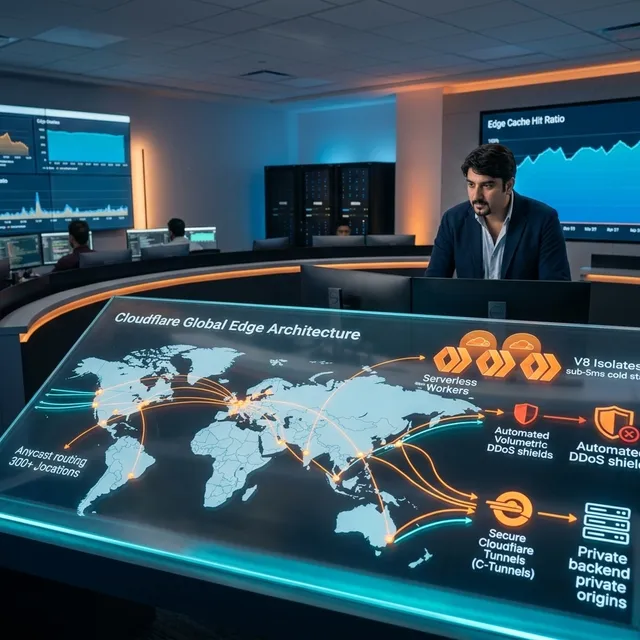
# Production Anycast Edge Routing & Origin Shielding Flow
[Global User Traffic / Browsers] → (BGP Anycast Routing → Nearest Edge PoP <20ms)
→ [Edge Perimeter Security]: Unmetered DDoS Mitigation & WAF Bot Defense
• Static Pages Requests → [Cloudflare Pages & Edge SSD Cache (>95% Hit Ratio)]
• Serverless Execution → [Cloudflare Workers: V8 Isolates with <5ms Cold Starts]
• Edge Data Query → [Workers KV, D1 Distributed SQL & R2 Object Storage]
• Internal Admin Access → [Cloudflare Zero Trust / Access (MFA + Device Posture)]
→ Dynamic Origin Routing → [Argo Smart Routing via Private Global Fiber Backbone]
→ [Egress-Only Cloudflare Tunnel (cloudflared)]: Zero Open Inbound Ports
→ [Origin Infrastructure]: Private VPC Containers on AWS, GCP & OCI
Cloudflare Anycast Global Ingress
Traffic terminates at the nearest of 300+ global edge locations, performing instant TLS 1.3 handshakes and filtering malicious packets before reaching compute layers.
V8 Isolate Serverless Compute (Workers)
Executing request inspection, auth validation, header decoration, and micro-routing in sub-5ms without container provisioning delays.
Tiered Caching & Argo Smart Routing
Upper-tier regional cache hierarchies shield backend origins from cache misses, while dynamic traffic navigates private global fiber links.
Egress-Only Cloudflare Tunnels (cloudflared)
Encrypted outbound tunnels connect protected private AWS or GCP instances directly to Cloudflare edge with zero open inbound firewall ports.
Authoritative Architecture Standard
“Cloudflare Workers provides a serverless execution environment that allows you to create entirely new applications or augment existing ones without configuring or maintaining infrastructure. Cloudflare Workers run on Cloudflare's global network in hundreds of cities worldwide.”
Every edge topology I design adheres directly to official Cloudflare architectural standards: zero cold-start V8 Isolate execution, declarative Terraform configuration, egress-only private tunnel shielding, and strict Zero Trust perimeter policies.
Edge Operating Model: Architecture & Methodology Evaluation
Comparing enterprise Cloudflare edge architecture against traditional CDNs and centralized origin hosting.
| Architectural Dimension | Cloudflare (Workers / Pages / Edge) | AWS CloudFront (Lambda@Edge) | Legacy Centralized Origin Hosting |
|---|---|---|---|
| Compute Cold Start Latency | < 5 ms (Google V8 Isolates initialized without container boots) | 50 - 250 ms (Micro-VM container provisioning delay) | No Native Edge Compute; requests route to central origin |
| Global Anycast Edge Scale | 300+ Cities Worldwide with unified single-hop Anycast BGP | 225+ Edge Locations with regional edge caches | Single centralized data center; high intercontinental latency |
| DDoS Capacity & Mitigation | 280+ Tbps Automated Unmetered Layer 3/4/7 threat absorption | AWS Shield (Tiered pricing with costly Advanced coverage) | Vulnerable to saturation; requires third-party scrubbing |
| Zero Trust Access & Tunnels | Egress-only Cloudflare Tunnels with zero open inbound ports | AWS Client VPN or private API Gateway requiring complex IAM | Open public SSH and web ports vulnerable to brute-force scans |
| Bandwidth Egress Costs | Free unmetered bandwidth between Cloudflare edge and origins | Substantial per-GB bandwidth egress fees from origin to CDN | Full origin host bandwidth fees with steep overage penalties |
| Edge Data Storage Primitives | Workers KV, D1 Distributed SQL, and R2 Object Storage at edge | DynamoDB Global Tables requiring cross-region data sync | Centralized SQL database; all queries traverse the globe |
Implementation Lifecycle
Structured 4-Phase Cloudflare Architecture Delivery Process
A predictable, phased engineering roadmap migrating DNS, shielding application origins, and deploying high-performance serverless compute to Cloudflare global edge.
- Phase 01
DNS Migration & SSL Setup
Audit existing DNS records, transition authoritative nameservers to Cloudflare with zero downtime, configure Full (Strict) SSL/TLS, and establish base WAF rules.
Duration: Week 1
- Phase 02
WAF Tuning & DDoS Shield
Deploy OWASP Top 10 managed rule sets, configure custom rate-limiting directives on login endpoints, and activate Bot Management to block scrapers.
Duration: Weeks 2–3
- Phase 03
Workers & Cache Engineering
Implement Cloudflare Workers for header decoration and auth checks, configure Tiered Caching with Cache Reserve, and deploy Pages static site frontends.
Duration: Weeks 4–5
- Phase 04
Zero Trust Tunnels & IaC
Deploy egress-only Cloudflare Tunnels (cloudflared) closing public inbound ports, enforce Zero Trust Access policies with MFA, and codify settings in Terraform.
Duration: Week 6
Core Cloudflare Architectural Modules I Engineer
Authoritative implementation across serverless edge computing, global CDN caching, Zero Trust networking, and threat mitigation.
Cloudflare Workers (V8 Isolates)
Executing compute logic inches from end users with sub-5ms cold starts, transforming headers, verifying JWTs, and running edge routing without origin latency.
Edge Pages Static Hosting
Deploying pre-rendered Astro and Jamstack static frontends directly to Cloudflare global network, achieving sub-50ms TTFB across all continents.
Automated Multi-Layer DDoS Shield
Absorbing multi-terabit volumetric Layer 3/4 SYN floods and application Layer 7 HTTP flood attacks at the edge before traffic ever touches client servers.
Zero Trust Access & Tunnels
Exposing internal staging databases and admin portals securely via Cloudflare Tunnels with hardware MFA, eliminating vulnerable public open ports.
Tiered Caching & Smart Routing
Routing cache misses across optimized private backbone fiber paths, slashing origin server bandwidth costs by 80-90% and accelerating global delivery.
Custom WAF Security Rules
Codifying OWASP Top 10 rule engines, rate-limiting directives, and bot-management challenges tailored specifically to protect application login endpoints.
Workers KV & D1 Distributed SQL
Integrating globally replicated key-value storage and SQLite-compatible distributed databases for instant edge lookups without central database calls.
Terraform Edge IaC Automation
Managing all DNS records, firewall rules, page rules, and worker routing mappings as version-controlled code using the Cloudflare Terraform Provider.
Real-Time Edge Logpush Telemetry
Streaming real-time HTTP request logs, WAF block events, and DNS query analytics directly to Datadog or encrypted object storage for compliance audits.
Production Cloudflare Technology Stack Architecture Matrix
A comprehensive overview of the technological layers and components engineered in every enterprise Cloudflare deployment.
Serverless Edge Compute
Cloudflare Workers (JavaScript/TypeScript/WASM), V8 Isolates, Worker Services, and Cron Triggers.
Static Hosting & Git CI/CD
Cloudflare Pages, automated GitHub/GitLab webhooks, preview deployments, and branch aliases.
Perimeter Cybersecurity
Web Application Firewall (WAF), Managed Rulesets, Bot Management, Rate Limiting, and Turnstile Captchas.
Zero Trust & Private Access
Cloudflare Access, Cloudflare Tunnels (cloudflared), Device Posture Checks, and WARP Gateway.
Edge Persistence & Storage
Workers KV, D1 Distributed SQL, R2 S3-Compatible Storage, and Hyperdrive connection multiplexing.
IaC & Observability
Terraform Cloudflare Provider, Wrangler CLI, Logpush real-time pipelines, and Trace Analytics.
Architectural Glossary
Core Cloudflare Technical Definitions & Concepts
Authoritative definitions of fundamental edge computing constructs, network routing algorithms, and cybersecurity protocols.
- Cloudflare Workers
- Cloudflare Workers is defined as a serverless execution environment that runs JavaScript, TypeScript, and WebAssembly across Cloudflare global network using V8 Isolates, executing code in sub-5ms without container cold starts.
- V8 Isolates
- V8 Isolates are defined as lightweight, secure execution contexts within a single Google V8 engine instance that run separate user scripts with dedicated memory boundaries, eliminating heavy process or virtual machine virtualization overhead.
- Anycast Network Routing
- Anycast Routing is defined as a network addressing technique where a single IP address is announced simultaneously from hundreds of global data centers, routing user traffic automatically to the geographically nearest point of presence via BGP routing.
- Cloudflare Tunnel (cloudflared)
- Cloudflare Tunnel is defined as a secure egress-only daemon running on origin servers that establishes outbound encrypted connections to Cloudflare network, enabling web routing without opening public inbound firewall ports.
- Cloudflare Pages
- Cloudflare Pages is defined as a Jamstack static site and full-stack edge platform that automates Git deployments and serves pre-rendered HTML/assets globally from edge SSD caches with unlimited bandwidth allowances.
- Zero Trust Access
- Zero Trust Access is defined as a perimeter-less security model that verifies identity, context, and device security posture for every individual user request before granting granular access to internal applications.
Complementary Technologies & Service Ecosystem
Explore related cloud, edge, and engineering practices across my technical architecture portfolio.
Astro Web Framework
Zero-JS static frontends pre-rendered and deployed globally across Cloudflare Pages edge network.
Amazon AWS Cloud Infrastructure
Multi-AZ backend infrastructure, container clusters, and Aurora databases shielded by Cloudflare edge.
DevOps & CI/CD Pipelines
Automating Cloudflare Workers and Pages releases directly via GitHub Actions and Terraform.
Enterprise Web Development
Full-lifecycle web design, custom Jamstack platforms, and performance-optimized edge deployments.
Data-Driven SEO Services
Core Web Vitals acceleration, edge caching tuning, sub-millisecond TTFB, and technical SEO audits.
Enterprise IT Consultancy Services
Strategic edge architecture reviews, Zero Trust migration plans, and cybersecurity hardening.
Authoritative References & Documentation
- Cloudflare Workers Documentation — Serverless edge execution model, V8 Isolates, and runtime APIs.
- Cloudflare Pages Documentation — Edge static site deployment, Git integrations, and build configurations.
- Cloudflare Zero Trust Architecture — SASE network architecture, Access policies, and Tunnel specifications.
- Cloudflare DDoS Learning Center — Global Anycast threat mitigation, Layer 3/4/7 attack analysis.
Edge Guidance
Frequently Asked Questions on Cloudflare Edge Architecture
Direct answers to critical questions regarding edge computing, DDoS mitigation, and Zero Trust access engineering.
Why choose Cloudflare Pages and Workers over traditional centralized origin hosting?
Traditional web hosting requires every user request across the globe to travel thousands of miles to a central origin server, introducing high latency. Cloudflare executes code and delivers cached static assets from over 300 edge data centers worldwide within 10-30 milliseconds of 95% of the global internet population, completely eliminating geographical latency.
How do Cloudflare Workers differ architecturally from AWS Lambda or Google Cloud Functions?
AWS Lambda and Google Cloud Functions spin up micro-VMs or Node.js containers that suffer from cold starts of 200-500ms when idle. Cloudflare Workers run on Google V8 Isolates—lightweight execution contexts that start in under 5 milliseconds with negligible memory overhead, enabling instantaneous edge routing, authentication, and request decoration.
How do I protect client platforms against massive volumetric DDoS and bot attacks?
I configure Cloudflare Web Application Firewall (WAF) coupled with Managed Bot Defense and custom rate limiting rules. Malicious scrapers, credential-stuffing bots, and multi-terabit volumetric SYN and UDP floods are absorbed and mitigated at Cloudflare Anycast edge before ever touching client backend origins.
How does Cloudflare Zero Trust secure enterprise internal administration tools?
Instead of clumsy legacy corporate VPNs that grant broad network access, I deploy Cloudflare Zero Trust (Access). Engineers and team members authenticate via identity providers protected by hardware-key MFA. Access to admin panels and staging APIs is enforced on a per-request basis with zero open inbound firewall ports via Cloudflare Tunnels.
How do I maximize CDN cache hit ratios for dynamic e-commerce and media platforms?
I configure Cloudflare Cache Rules with Tiered Caching, Cache Reserve, and custom surrogate cache tags. Static assets, images, and pre-rendered pages achieve >95% cache hit ratios, while dynamic origin requests pass through Cloudflare Argo Smart Routing to traverse optimal global fiber routes.
How do Cloudflare Tunnels (cloudflared) eliminate public attack surfaces?
Cloudflare Tunnels create a lightweight, outbound-only connection between your origin servers and Cloudflare global network. Because the tunnel is egress-only, origins require zero open public inbound ports, completely shielding backend IP addresses from direct port scans, exploits, and origin-targeted DDoS attacks.
Can Cloudflare Workers handle distributed edge databases and key-value state?
Yes. Cloudflare provides native edge data primitives: Workers KV for high-read global caching, D1 for serverless distributed SQL queries, and R2 for S3-compatible zero-egress-fee object storage. These enable full serverless applications to execute and persist state without round-trips to distant cloud regions.
How does Cloudflare integrate into my broader full-stack and SEO services?
Cloudflare forms the edge shield and delivery layer for all my web platforms. It accelerates static Astro frontends, protects Laravel and Node.js APIs, and optimizes Core Web Vitals (TTFB, LCP) for maximum search rankings, detailed across my Web Development and Technical SEO Practices.
Let’s Connect
Ready to Shield & Accelerate Your Platform with Cloudflare?
Schedule a direct technical consultation with an enterprise edge architect. Discuss your global CDN caching, DDoS mitigation, or Zero Trust access rollout with actionable engineering milestones.