

Enterprise Engineering Service
Autonomous AI Agents & Enterprise LLM Chatbots for Scalable Systems
Hybrid RAG Knowledge Retrieval, Deterministic Guardrails & Tool Calling.We engineer production-ready autonomous AI agents and enterprise chatbots that act as digital workers. Combine hybrid retrieval-augmented generation (RAG), strict prompt boundaries, and secure API function calling to automate support, qualify leads, and orchestrate complex business workflows with zero hallucinations.
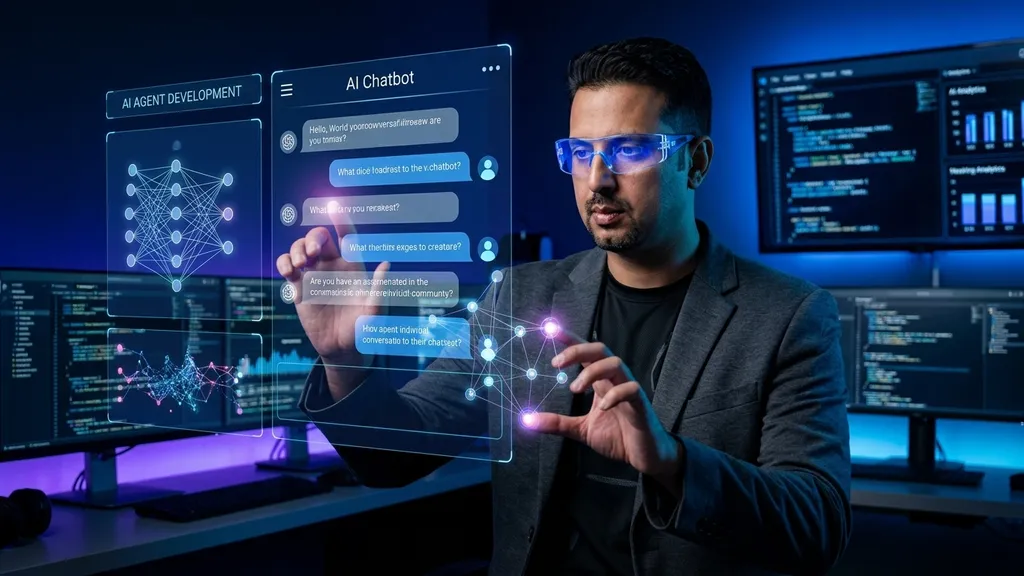
What is Enterprise Autonomous AI Agent Engineering?
Enterprise Autonomous AI Agent Engineering is a specialized software systems discipline that designs, grounds, and deploys intelligent software agents capable of autonomous reasoning, dynamic tool execution, and multi-step workflow orchestration. Unlike basic prompt-wrapper chatbots that merely output static text, autonomous enterprise agents integrate hybrid Retrieval-Augmented Generation (dense vector search combined with sparse BM25 keyword matching) to guarantee zero-hallucination accuracy. They deploy deterministic schema guardrails, connect to live enterprise databases and REST APIs via function calling, and operate within private cloud boundaries—ensuring complete enterprise data sovereignty, SOC2 compliance, and 100% intellectual property ownership.
Agentic Engineering Benchmarks
Measurable performance gains delivered through custom retrieval tuning and autonomous tool calling.
The Architecture Challenge
The Hidden Cost of Outdated Support & Manual Operations
Why generic chatbots and slow manual workflows drain enterprise capital, frustrate customers, and leak proprietary data.
Rigid Rule-Based Bots & Customer Frustration
Old-school decision tree bots infuriate customers by failing to understand natural language intent, forcing high-value leads to abandon your site after hitting repetitive dead-end menus.
Hallucinating Foundation Models & Liability Risks
Connecting raw, ungrounded LLMs directly to customer-facing channels leads to fabricated pricing quotes, brand promises you cannot keep, and severe reputational damage without source citation validation.
Overburdened Human Teams & High Payroll Churn
Forcing tier-1 human agents to manually answer the same repetitive onboarding questions creates massive response backlogs, employee burnout, and ballooning support payroll that scales linearly with growth.
Enterprise Data Leakage & Compliance Exposure
Allowing employees to paste sensitive internal documents and customer PII into public AI tools violates GDPR, HIPAA, and SOC2 regulations, exposing your proprietary IP to third-party model training.
Moving Beyond Generic Prompt Wrappers
Most off-the-shelf AI chatbot tools are nothing more than fragile wrappers around third-party APIs. They lack source-level verification, hallucinate answers under stress, and cannot safely execute multi-step business transactions.
We engineer AI as an integrated enterprise software system. By combining high-density vector retrieval, deterministic output guardrails, and event-driven microservices on Node.jsand Google Cloud (GCP), we deliver autonomous agents that work reliably inside your existing software ecosystem.
Discover how our agentic workflows integrate directly with transactional backends in Laravel, interactive frontend portals in Web Development, and strategic governance in IT Consultancy.
Hybrid Retrieval-Augmented Generation (RAG)
We combine semantic dense vector embeddings with sparse keyword matching (BM25) over your documentation. Responses are grounded strictly in your verified files with clickable source passage citations.
Autonomous Tool Use & Live Enterprise APIs
Our agents do not just chat—they act. Using function calling, agents securely query your SQL database, trigger webhooks, book appointments, and update CRM lead statuses in real time.
Deterministic Guardrails & Human Escalation
We deploy strict prompt boundary filters and real-time sentiment scoring. When a query is outside scope or sensitive, the agent immediately escalates to human agents with full conversational context.
Semantic Caching & Token Cost Optimization
In-memory vector caching and intelligent small-model routing to minimize token spend, cutting recurring inference overhead by up to 60%.
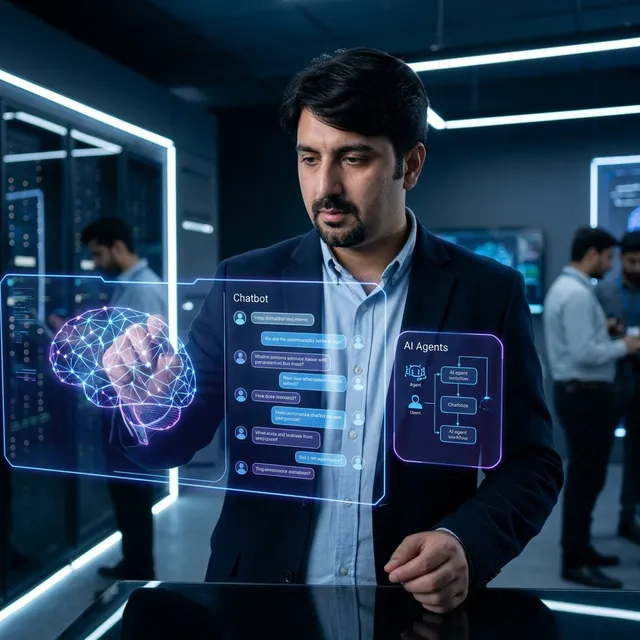
User Query → Intent Classification & Prompt Boundary Guardrails → Hybrid RAG (Dense Vectors & Sparse BM25) → LLM Reasoning & Function Calling → Tool Execution (SQL / REST API) → Output Schema Validation → Streaming Response.
“True enterprise conversational AI is not a prompt wrapper around a public LLM; it is a deterministic state machine equipped with verifiable vector retrieval, rigorous boundary guardrails, and secure API execution capabilities.”— Goher K, Principal Solutions Architect at iGoher
Architectural Rigor
Generic Chatbot Builders vs. iGoher AI Agent Architecture
See the practical technical difference between off-the-shelf prompt wrappers and hardened enterprise agentic engineering.
| Agentic Dimension | Generic Chatbot BuilderShallow prompt wrappers | iGoher AI Agent ArchitectureEnterprise agentic engineeringRecommended |
|---|---|---|
| Knowledge Retrieval ArchitectureDocument indexing & search precision | Basic text scrapers prone to context dilution and hallucinated facts | Hybrid RAG pipelines with semantic vector embeddings & BM25 re-ranking |
| Tool Execution & API ActionsAutonomous software capability | Static text matching with zero ability to interact with live software | Secure function calling executing live SQL queries, CRMs & payment actions |
| Hallucination Defense & CitationsFactual accuracy verification | Model guesses answers when context is missing without citation | Deterministic output validators enforcing strict clickable passage citations |
| Data Sovereignty & PrivacyEnterprise security standards | Data stored in multi-tenant shared clouds with public model risk | Private VPC deployment with zero-retention enterprise SOC2 guarantees |
| Multi-Agent OrchestrationComplex workflow handling | Single monolithic prompt attempting to handle all user workflows | Specialized multi-agent teams (Router, Researcher, Executor) via state machines |
| Token Optimization & LatencyOngoing inference spend & TTFT | Massive repetitive prompts resulting in high costs and 4s+ latency | Semantic vector caching & dynamic model routing cutting token spend by 60% |
Structured Delivery
The 4-Phase AI Agent Engineering Process
Every agentic engineering engagement follows a disciplined four-phase sequence to ensure factual precision, tool security, and rapid production deployment.
- 1
Phase 1: Ingestion Pipeline & Architecture Blueprint
We evaluate your enterprise documentation, plan document chunking strategies, set up high-throughput vector databases (Qdrant or pgvector), and define domain boundary guardrails.
- 2
Phase 2: Hybrid RAG Tuning & Guardrail Engineering
We combine semantic dense vector search with sparse BM25 keyword matching, configure cross-encoder re-rankers, and build deterministic output schema filters to eliminate hallucinations.
- 3
Phase 3: Tool Function Calling & API Integration
We build secure REST and SQL function-calling middleware, connect agents to your live CRM, ERP, and payment gateways, and configure contextual human-in-the-loop escalation workflows.
- 4
Phase 4: Red-Teaming, Observability & Full Handover
We execute adversarial prompt injection penetration testing, deploy LangSmith observability telemetry, optimize semantic caching to reduce token spend, and transfer 100% code repositories and vector pipelines.
Scope of Work
Functional Engineering Modules & Deliverables
Every module is delivered with production-ready agent code, automated vector pipelines, safety benchmarks, and zero technical debt.
Module 1: Enterprise Document Ingestion & RAG
Deliverable: Vector database indexing of PDFs, databases, knowledge bases, and API docs.
Tools: LlamaIndex, Qdrant, pgvector.
Handover: Automated vector sync pipeline and indexing documentation.
Module 2: Custom Tool & API Function Calling
Deliverable: Secure REST/SQL tool execution enabling agents to read and write data in live software.
Tools: FastAPI, Function Calling APIs.
Handover: Documented tool schema repository and execution runbooks.
Module 3: Deterministic Safety Guardrails
Deliverable: Prompt injection defense, PII masking, tone compliance, and hallucination filters.
Tools: Guardrails AI, NeMo Guardrails.
Handover: Safety audit and red-teaming report.
Module 4: Human-in-the-Loop (HITL) Handoff
Deliverable: Contextual live chat escalation with summary context for human agents.
Tools: Zendesk, Intercom, Slack Webhooks.
Handover: Handoff routing workflow map and escalation rules.
Module 5: Semantic Caching & Cost Optimization
Deliverable: In-memory vector caching and intelligent small-model routing to minimize token spend.
Tools: Redis, GPT-4o-mini, Claude 3.5 Haiku.
Handover: Cost & latency telemetry dashboard.
Module 6: Evaluation Framework & Observability
Deliverable: Full conversational tracing, prompt versioning, and automated accuracy scoring.
Tools: LangSmith, OpenTelemetry.
Handover: Production observability portal access and accuracy benchmarks.
Enterprise Technology Matrix
Production-Grade Agentic Technologies & Standards
Selected for maximum retrieval precision, sub-second latency, and enterprise compliance maturity.
LangChain & LlamaIndex
Industry-standard orchestration frameworks for complex document chunking, routing, and agent loops.
Qdrant & PostgreSQL pgvector
High-throughput, scalable vector databases handling millions of semantic embeddings with sub-millisecond lookups.
Claude 3.5, OpenAI & Gemini
Premier foundation LLMs selected dynamically based on task complexity, reasoning depth, and speed.
FastAPI & Python Microservices
Ultra-low latency asynchronous API backends supporting streaming tokens via Server-Sent Events (SSE).
LangSmith & OpenTelemetry
Deep LLM observability, trace recording, token cost attribution, and automated ground-truth evaluation.
NeMo & Guardrails AI
Hardened safety filters enforcing prompt containment, PII redaction, and deterministic schema outputs.
Core Architecture Glossary
Technical Definitions & Agentic AI Concepts
Authoritative definitions of enterprise conversational AI, vector search, and autonomous agent terms.
- Retrieval-Augmented Generation (RAG)
- Retrieval-Augmented Generation (RAG) is defined as an AI architectural pattern that retrieves relevant factual passages from an external private knowledge base before prompting the LLM, ensuring responses are completely grounded in company facts rather than hallucinated.
- Vector Embeddings & Semantic Search
- Vector Embeddings are defined as high-dimensional mathematical array representations of text concepts that allow search algorithms to match user queries by conceptual meaning and intent, rather than relying exclusively on exact keyword matches.
- Autonomous Tool Calling
- Autonomous Tool Calling (Function Calling) is defined as the capability of an LLM to decide when an external tool is required, output structured JSON arguments for an API or database query, and interpret the returned output to complete a user task.
- Deterministic Guardrails
- Deterministic Guardrails are defined as programmatic safety filters running before and after the model generates text to block prompt injection attacks, redact sensitive Personally Identifiable Information (PII), and enforce output schemas.
- Human-in-the-Loop (HITL) Protocol
- The Human-in-the-Loop (HITL) Protocol is defined as a system architecture where edge cases, low-confidence answers, or sensitive actions require human agent verification or handover, ensuring mission-critical tasks are never executed unchecked.
- Semantic Caching
- Semantic Caching is defined as an in-memory vector cache that matches incoming questions to previously answered queries with high semantic similarity, returning verified answers in milliseconds with zero LLM token costs.
Complementary Services & Architecture Ecosystem
Explore related enterprise development services and cloud intelligence platforms.
Full-Stack Web Development
Interactive AI web portals, streaming chat interfaces, and conversion-optimized agent frontends.
Divi 5 Theme Expert Services
Integrate custom AI assistant modules, lead bots, and conversational agents natively into Divi 5 layouts.
Laravel Backend Architecture
Transactional database systems, queue workers, and secure API bridges for AI agent task execution.
Enterprise IT Consultancy
Strategic AI adoption blueprints, data privacy compliance, and cloud infrastructure architecture.
Node.js & Streaming Runtimes
High-throughput asynchronous event loops and Server-Sent Events (SSE) for low-latency LLM streaming.
Google Cloud (GCP) Intelligence
Vertex AI integration, Cloud Run container hosting, BigQuery analytics, and multi-cloud connectivity.
Relational & Vector Databases
pgvector semantic search, PostgreSQL schema modeling, and Redis high-speed semantic memory caches.
Cross-Platform Mobile Apps
Flutter iOS and Android applications with native AI chatbot widgets and real-time streaming interfaces.
Direct Technical Answers
Frequently Asked Questions
Clear answers to common questions about custom AI chatbots, autonomous agents, and enterprise LLM integration.
How do you prevent AI hallucinations and ensure answers are factually grounded?
We implement hybrid Retrieval-Augmented Generation (RAG) combining dense vector search with sparse keyword matching (BM25) over your verified documentation. Every answer is constrained by strict prompt boundary guardrails, required to cite exact source document passages, and validated by deterministic output filters before reaching the user.
What is the architectural difference between a basic chatbot and an autonomous AI agent?
A basic chatbot only answers conversational questions based on matching text. An autonomous AI agent possesses reasoning loops, persistent memory, and tool-calling capabilities. Agents can interact with your software—querying SQL databases, booking meetings, issuing Stripe refunds, and triggering API webhooks without human intervention.
How do you ensure our proprietary enterprise data is never used to train public AI models?
We deploy enterprise zero-data-retention APIs (OpenAI, Anthropic Claude, Google Vertex AI) and self-hosted open-source LLMs (Llama 3, Mistral) within private VPC boundaries. Your corporate documents, embeddings, and chat histories are encrypted at rest and in transit, with strict contractual guarantees that your data is never used for foundation model training.
How do human-in-the-loop (HITL) handoffs work when the AI encounters an edge case?
Our systems monitor confidence scoring and sentiment analysis in real time. If a user expresses dissatisfaction or the query falls outside verified knowledge boundaries, the agent executes an immediate, contextual handoff to your human support team via Zendesk, Intercom, or Slack, providing human agents with a concise executive summary.
Which vector databases and AI frameworks do you build on?
We architect scalable agentic systems using LangChain, LlamaIndex, LangGraph, and CrewAI, backed by high-performance vector stores including PostgreSQL pgvector, Qdrant, Pinecone, and Weaviate. Backends are built on Python FastAPI and Node.js for sub-second streaming response times.
Can an AI agent connect directly to our legacy internal CRM or ERP software?
Yes. We build custom API connectors and secure middleware exposing your internal endpoints (REST, GraphQL, SQL) as callable tools. The AI agent uses structured JSON function calling to retrieve customer records, update CRM statuses, and trigger order processing in compliance with your existing role-based access controls.
What are the ongoing inference and token costs, and how do you optimize them?
We drastically reduce recurring API costs by implementing semantic caching (storing repeated answer vectors), smart prompt compaction, and intelligent model routing—using lightweight, low-cost models (e.g., Claude 3.5 Haiku or GPT-4o-mini) for classification and routing, and reserving high-tier reasoning models only for complex synthesis.
What is your development timeline and process for shipping a custom AI agent?
Production deployments follow a 4-phase agile methodology: Data ingestion and embedding pipeline setup (Week 1), RAG retrieval tuning and guardrail engineering (Week 2), Tool calling and CRM integration (Week 3), followed by red-teaming safety evaluation, latency optimization, and production deployment (Week 4).
Let’s Connect
Ready to Automate Your Operations with Custom AI Agents?
Schedule a direct technical consultation with our principal solutions architect. Share your use case, data sources, and operational goals below to review your agentic architecture blueprint.