

Enterprise Relational Data Architecture & Clustering
PostgreSQL & MySQL Database Architecture & High-Availability Systems
Mission-critical relational schema modeling, high-throughput ACID transactional integrity, sub-millisecond query optimization, and resilient multi-region clustering for enterprise systems.

What Is Enterprise Relational Database Architecture?
Relational Database Architecture is an enterprise data engineering discipline that models, scales, and safeguards transactional data stores across PostgreSQL and MySQL. It unifies rigorous schema normalization, transaction-level connection pooling (PgBouncer), composite B-Tree/GIN indexing, and multi-AZ replication to ensure 100% ACID compliance and sub-5ms query performance.
Production-Validated Data Integrity & Performance
Engineered for high query concurrency, strict ACID compliance, and zero data loss.
Critical Database Architectural Challenges & Performance Traps
Four systemic relational failure points that trigger severe query degradation, table locks, and data loss.
Unindexed Scans & Slow Query Table Locks
Missing composite indexes force the database engine to execute full table scans across millions of rows, locking tables and exhausting CPU capacity. I profile execution plans with EXPLAIN ANALYZE to create targeted B-Tree and GIN indexes.
Connection Pool Saturation & Memory Crashes
Opening hundreds of direct application database connections consumes gigabytes of server RAM, driving backend processes into out-of-memory crashes. I implement transaction-level PgBouncer pooling that multiplexes thousands of clients across minimal backend threads.
Blocking DDL Migrations & Downtime Outages
Running naive ALTER TABLE statements on multi-gigabyte tables acquires exclusive metadata locks that queue incoming requests until web workers crash. I enforce zero-downtime migrations using non-blocking online tools and concurrent index builds.
Unverified Backups & Replication Failures
Assuming untested nightly backups will restore cleanly during a catastrophe leads to multi-day downtime and permanent data loss. I implement automated weekly restoration drills that spin up staging clusters from WAL archives to verify data checksums.
Engineered Architecture: Production Topology & Security Perimeter
Technical Blueprint
Safeguarding Business-Critical Data at Enterprise Scale
An application is only as resilient and fast as the relational database beneath it. In my consulting practice, database architectures are deeply integrated with enterprise backends and multi-cloud container runtimes.
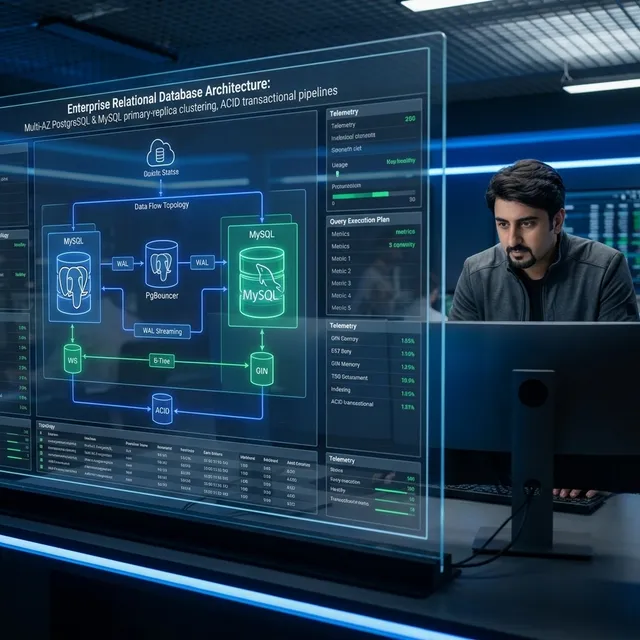
# Production Traffic & High-Availability Replication Flow
[Application Clients / APIs] → (Internal Load Balancer & TLS)
→ [Connection Pooler Tier: PgBouncer / ProxySQL Multiplexers]
• Write Transactions → [Primary Master Database (Multi-AZ Multi-Threaded)]
• Synchronous WAL Stream → [High-Availability Failover Standby (<30s RTO)]
• Asynchronous Replication → [Read-Replica Pool for Reporting Queries]
• Read Cache Requests → [Redis In-Memory Caching Cluster]
• Continuous Backup → [Encrypted Cloud Storage WAL Archives (RPO = 0)]
→ [Security Perimeter]: Non-Routable Private Subnets & Role-Scoped IAM
Transaction-Level Connection Multiplexing
PgBouncer and ProxySQL instances decouple client connection spikes from the relational core, keeping database process memory lean and predictable under extreme concurrency.
Multi-AZ Read Replicas & Load Balancing
Synchronous primary-replica clustering with automated failover in under 30 seconds, routing read-heavy reporting queries away from the primary transactional write master.
In-Memory Redis Caching Tier
Shielding relational storage from repetitive read queries by caching hot entities and session states in Redis clusters with atomic invalidation tags.
Continuous WAL Archiving & Point-In-Time Recovery
Streaming Write-Ahead Logs directly to encrypted object storage buckets ensures deterministically reproducible restoration drills with zero data loss.
Authoritative Architecture Standard
“PostgreSQL is a powerful, open source object-relational database system with over 35 years of active development that has earned it a strong reputation for reliability, feature robustness, and performance.”
Every relational database architecture I design adheres directly to official engine standards: strict third-normal form normalization, zero-loss Write-Ahead Logging, transaction-level connection management, and proven disaster recovery procedures.
Database Operating Model: Ad-Hoc Setup vs Engineered Architecture
Comparing default unmanaged database configurations against enterprise, high-availability relational engineering.
| Architectural Dimension | Engineered Database Architecture (iGoher Standard) | Unmanaged Ad-Hoc Database Prototype | Generic Shared Multi-Tenant Hosting |
|---|---|---|---|
| Schema Integrity & Normalization | Strict 3NF schema modeling with explicit foreign keys, check constraints, and typed fields. | Missing foreign key constraints and loose data types that permit orphaned and corrupted records. | Uncontrolled flat tables with duplicate records and zero relational consistency rules. |
| Query Indexing & Optimization | Targeted composite, partial, and covering B-Tree/GIN indexes based on EXPLAIN ANALYZE. | Missing indexes causing full table scans, table locks, and severe database CPU exhaustion. | Default primary key indexing only; complex queries stall shared CPU threads indefinitely. |
| Connection Pooling & Multiplexing | PgBouncer/ProxySQL transaction pooling multiplexing thousands of clients on minimal threads. | Direct application connections exhausting backend memory and triggering max_connections errors. | Rigid connection limits with frequent connection dropouts and timeout exceptions. |
| High Availability & Failover | Multi-AZ synchronous replication with automated failover in under 30 seconds and read-replica pools. | Single standalone database node; hardware or rack failure causes multi-hour total outages. | Shared database instances with no dedicated failover mechanisms or read replicas. |
| Zero-Downtime Migration (DDL) | Non-blocking online schema evolution (gh-ost, pt-online-schema-change, CONCURRENTLY indexes). | Locking ALTER TABLE commands executed live, blocking user traffic and causing app timeouts. | Manual table edits via web interfaces requiring extensive scheduled maintenance downtime. |
| Backup & Disaster Recovery | Continuous WAL streaming with PITR recovery to encrypted buckets and automated weekly drills. | Nightly dump scripts stored locally; backups are never restored or verified for table integrity. | Generic host snapshots with no point-in-time recovery and high potential data loss windows. |
Implementation Lifecycle
Structured 4-Phase Database Architecture Delivery Process
A predictable, phased delivery roadmap transforming struggling data layers into high-throughput, enterprise-grade relational database architectures.
- Phase 01
Schema Audit & Query Profiling
Examine slow query logs, table sizes, lock contention, and index usage metrics using pg_stat_statements or MySQL slow log to pinpoint bottlenecks.
Duration: Week 1
- Phase 02
Index Engineering & Modeling
Restructure problematic schemas, author composite and partial indexes, configure foreign key constraints, and optimize slow execution plans.
Duration: Weeks 2–3
- Phase 03
Pooling & Multi-AZ Replicas
Deploy transaction-level PgBouncer/ProxySQL poolers, configure multi-AZ read-replica pools, and set up Redis query result caching tiers.
Duration: Weeks 4–5
- Phase 04
Zero-Downtime Cutover & DR
Execute zero-downtime data cutover, establish automated WAL log archiving to cloud storage, run restoration drills, and deliver team documentation.
Duration: Week 6
Core Relational Database Modules I Engineer
Authoritative implementation across relational schema design, query optimization, connection multiplexing, and disaster recovery.
Rigorous Schema Modeling
Third-normal form relational structures with selective strategic denormalization, explicit foreign key constraints, and check validations preventing corrupt data entry.
Advanced Execution Plan Tuning
Deep profiling using EXPLAIN ANALYZE, eliminating sequential table scans through composite, partial, and covering B-Tree and GIN indexes tailored to production query patterns.
Connection Pooling Multiplexing
Deploying PgBouncer or ProxySQL transaction-level poolers to prevent connection exhaustion, allowing thousands of application clients to share minimal database threads.
Multi-AZ Read Replicas
Isolating intensive read and reporting traffic from write transactions via asynchronous and synchronous read replicas behind intelligent database routing proxies.
Zero-Downtime Schema Evolution
Non-blocking migration strategies utilizing online DDL tools (gh-ost, pt-online-schema-change, CONCURRENTLY indexes) ensuring 24/7 service availability during schema updates.
Automated Continuous DR & WAL Archiving
Write-Ahead Log streaming combined with encrypted point-in-time recovery (PITR) snapshots ensuring zero data loss and deterministic disaster recovery execution.
Transparent Data Encryption (TDE)
Enforcing enterprise data security with mutual TLS in transit, tablespace-level encryption at rest, and automated customer-managed cryptographic key rotation.
Table Partitioning & Cold Archiving
Declarative range and list partitioning for high-volume event tables, routing historical data to cold storage while keeping hot working datasets compact and fast.
Automated Slow Query Auditing
Aggregating query execution telemetry via pg_stat_statements and slow query logs with automated alerts that notify teams before bottlenecks impact end users.
Relational Database Production Stack Architecture Matrix
A comprehensive overview of the technological layers and components engineered in every enterprise database deployment.
Relational Engines
PostgreSQL 16+, MySQL 8.0+ (InnoDB), AWS Aurora PostgreSQL/MySQL, and Google Cloud SQL.
Connection Multiplexers
PgBouncer (transaction pooling), ProxySQL, AWS RDS Proxy, and connection circuit breakers.
In-Memory Caching
Redis Enterprise clusters, Redis Sentinel, Memcached, and application-level cache invalidation tags.
High Availability & Replication
Multi-AZ synchronous replication, asynchronous read replicas, Patroni, and automated failover.
Migration & DDL Tools
gh-ost, pt-online-schema-change, Flyway, Liquibase, and concurrent index creation scripts.
Observability & Backups
pg_stat_statements, Percona PMM, Datadog APM, continuous WAL archiving, and automated restoration drills.
Architectural Glossary
Core Database Technical Definitions & Concepts
Authoritative definitions of fundamental database mechanisms, transactional guarantees, and concurrency controllers.
- ACID Guarantees
- ACID is defined as the four fundamental transactional guarantees—Atomicity (all or nothing), Consistency (valid states), Isolation (concurrent safety), and Durability (permanent persistence)—that ensure relational data reliability.
- Multi-Version Concurrency Control (MVCC)
- MVCC is defined as a concurrency control method that presents each transaction with a snapshot of data at a specific point in time, enabling readers not to block writers and writers not to block readers.
- Write-Ahead Logging (WAL)
- WAL is defined as an append-only logging technique where database modifications are recorded to disk prior to modifying underlying data pages, ensuring crash recovery durability and enabling point-in-time replication.
- Connection Pooling (PgBouncer)
- PgBouncer is defined as a lightweight connection pooler for PostgreSQL that multiplexes incoming client connections across a smaller pool of active server backend processes, dramatically reducing memory overhead.
- GIN & B-Tree Indexing
- B-Tree Indexing provides balanced logarithmic key searches for equality and range comparisons, whereas Generalized Inverted Index (GIN) maps multiple keys to a single tuple, ideal for JSONB and full-text document searches.
- Read Replica Topologies
- A Read Replica is defined as a secondary database instance that continuously synchronizes data from a primary master node, offloading read-heavy queries, analytical reporting, and search workloads from the transactional engine.
Complementary Technologies & Service Ecosystem
Explore related backend, cloud, and architecture technologies across my technical portfolio.
Laravel Backend Architecture
Eloquent ORM optimizations, transactional queue workers, and Filament admin systems on PostgreSQL.
Amazon AWS Cloud Infrastructure
Amazon Aurora Multi-AZ clusters, RDS PostgreSQL, automated read replicas, and DynamoDB key-value stores.
Oracle Cloud Infrastructure (OCI)
Oracle Autonomous Database, bare-metal high IOPS compute shapes, and multi-cloud database interconnects.
Node.js & Microservices Runtimes
Prisma, Drizzle, and high-throughput connection pooling architectures for Node.js microservices.
DevOps & Infrastructure Automation
Automated database schema migrations in CI/CD, backup testing, and Terraform infrastructure management.
Enterprise IT Consultancy Services
Comprehensive database health audits, query bottleneck profiling, and database migration roadmaps.
Authoritative References & Documentation
- Official PostgreSQL Documentation — Concurrency control, index types, performance tuning, and MVCC specifications.
- MySQL 8.0 Reference Manual — InnoDB storage engine architecture, replication guides, and query optimization.
- PgBouncer Architectural Guide — Lightweight connection pooling architectures for high-concurrency environments.
- Redis Core Documentation — In-memory data caching, Pub/Sub channels, and persistence strategies.
Database Guidance
Frequently Asked Questions on Relational Database Architecture
Direct answers to critical questions regarding database scaling, query tuning, replication, and disaster recovery.
How do I decide between PostgreSQL and MySQL for an enterprise application?
I recommend PostgreSQL when an application requires advanced relational features: complex analytical queries (window functions, CTEs), native JSONB querying with GIN indexing, spatial data (PostGIS), custom data types, and strict ANSI SQL compliance. I recommend MySQL for read-heavy web applications, standard transactional e-commerce where simple replication topologies and ubiquitous hosting compatibility are primary priorities.
How do I eliminate database performance bottlenecks and slow query locks?
I conduct deep query execution plan analysis using EXPLAIN (ANALYZE, BUFFERS). Remediation includes composite indexing tailored to WHERE and JOIN predicates, partial indexes for skewed boolean columns, covering indexes to enable index-only scans, and denormalizing or materializing costly aggregated views. I also implement strict query timeout limits to prevent rogue transactions from holding row locks.
How do I scale relational databases to handle thousands of concurrent queries?
I decouple read traffic from write traffic using read-replica pools behind database load balancers (ProxySQL or AWS Aurora Reader Endpoints). For connection saturation, I deploy lightweight connection poolers (PgBouncer in transaction pooling mode for PostgreSQL, ProxySQL for MySQL) that reuse persistent database connections, slashing memory overhead.
How do I execute zero-downtime database schema migrations on multi-terabyte tables?
I execute non-blocking migration patterns: adding columns with default values without table locks, creating indexes concurrently (CREATE INDEX CONCURRENTLY in PostgreSQL), and running large column alterations using gh-ost or pt-online-schema-change in MySQL. Complex schema changes follow expand-contract architectural phases over multiple deployment steps.
What disaster recovery and backup strategies guarantee zero data loss (RPO = 0)?
I enforce automated continuous write-ahead log (WAL) archiving paired with daily storage snapshots. In hyperscale cloud environments (AWS Aurora, Google Cloud SQL, OCI), multi-AZ synchronous replication guarantees sub-30 second failover with automated promotion of replicas if a primary database node fails.
How do I prevent database connection pool saturation during sudden traffic spikes?
I configure transaction-level pooling proxies like PgBouncer or AWS RDS Proxy that decouple tens of thousands of ephemeral application clients from a small, dedicated pool of 50-100 direct database backend connections. This eliminates the severe RAM exhaustion and context-switching overhead that crashes unmanaged databases under spike loads.
When should an enterprise use native JSONB in PostgreSQL vs dedicated NoSQL?
PostgreSQL JSONB with GIN indexing provides the ideal hybrid pattern: storing polymorphic, evolving document structures while preserving relational foreign keys, ACID transactions, and JOIN capabilities with core entities. I recommend dedicated NoSQL (like MongoDB or DynamoDB) only when write volumes require horizontal multi-master sharding beyond a single database node.
How does database architecture integrate into my broader full-stack engineering practice?
Databases are the bedrock of all digital applications. I design resilient data schemas and query layers that power high-concurrency backends in Laravel, enterprise Node.js microservices, and multi-cloud infrastructure, documented across my Laravel Backend and IT Consultancy Practices.
Let’s Connect
Ready to Architect a Resilient Relational Database?
Schedule a direct technical consultation with an enterprise database architect. Discuss your schema design, query bottleneck remediation, or high-availability clustering with concrete delivery milestones.