

Enterprise Version Control & CI/CD
Enterprise Git & GitHub Architecture & CI/CD Automation Pipelines
I architect high-velocity Git workflows, scalable GitHub Actions CI/CD matrix pipelines, secret-less OIDC cloud authentication, and automated DevSecOps governance to accelerate engineering throughput without security compromises.

Executive Definition
Enterprise Git & GitHub Engineering: Velocity Through Discipline
Modern version control is far more than code storage—it is the central nervous system of modern software engineering. An enterprise Git architecture coordinates multi-team collaboration, protects production stability through automated branch rulesets, enforces security compliance via static analysis, and triggers automated CI/CD deployment pipelines.
Trunk-Based Delivery
Short-lived branches merged daily to main behind feature flags, eliminating catastrophic merge debt.
GitHub Actions CI/CD
Matrix workflows running parallel test runners, linting, and multi-stage container builds with dependency caching.
Secret-Less OIDC Auth
Short-lived cryptographic token exchange between GitHub and AWS/GCP, completely banning static cloud keys.
Production-Validated CI/CD Velocity & Reliability Standards
Measurable benchmarks achieved across enterprise GitHub organizations and automated deployment pipelines.
Risk Mitigation
Enterprise Version Control Bottlenecks & Engineering Solutions
How disciplined Git architecture resolves common collaboration barriers, security risks, and slow delivery pipelines.
Merge Debt & Branch Divergence
Long-lived feature branches accumulate hundreds of conflicting commits. I implement Trunk-Based Development with linear rebasing and small pull requests to eliminate merge hell.
Secret Exposure in CI/CD Runners
Hardcoded cloud API credentials stored in repository secrets risk catastrophic leakage. I configure OpenID Connect (OIDC) federation, eliminating static cloud credentials completely.
Bloated, Slow Pipeline Execution
Uncached package dependencies and serial build stages slow developer feedback loops. I configure GitHub Actions caching actions and matrix runners, cutting build times by over 60%.
Unsigned Commits & Rogue Code Ingress
Unverified commits bypass peer review policies. I establish strict GitHub Rulesets requiring mandatory GPG commit signing, branch linear history, and two designated CODEOWNER approvals.
Vulnerable Third-Party Dependencies
Outdated libraries introduce severe supply chain vulnerabilities. I automate continuous CVE detection using Dependabot alerts, automated security updates, and CodeQL SAST code scans.
Manual Versioning & Inconsistent Tags
Manual release tagging produces release discrepancies and broken changelogs. I implement semantic-release automation driven by Conventional Commits for automated changelogs and zero-error tagging.
Enterprise Git & GitHub Reference Architecture Blueprint
Technical Blueprint
Disciplined Version Control Over Chaotic Branch Sprawl
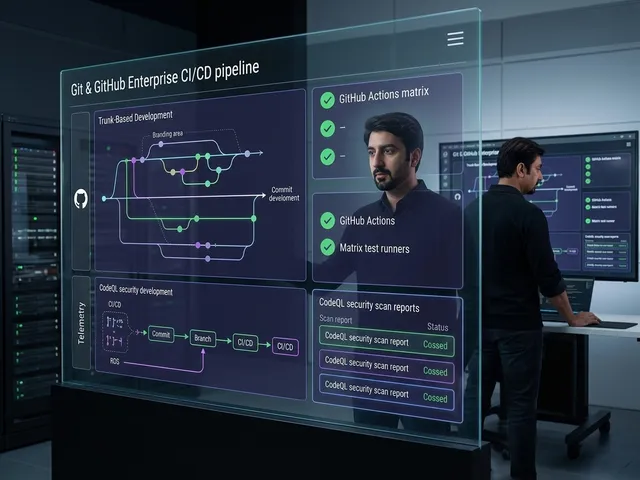
High-performing engineering teams treat Git repositories as an immutable audit log and automated delivery vehicle. Disciplined trunk-based practices guarantee rapid iteration, zero merge debt, and automated security verification.
# Git Workflow & Automated CI/CD Pipeline Ingress
[Developer Feature Branch] → (GPG Signed Commit & PR Creation)
→ [GitHub Actions CI Matrix Execution]
• CodeQL SAST Scan & Dependabot Dependency Audit
• Parallel Linters & Unit Test Suite Execution
• Multi-Platform Docker Container Build & Trivy Scan
→ [CODEOWNERS Approval & Linear Merge into Main]
→ [OIDC Cryptographic Auth into AWS IAM / GCP Workload Identity]
→ [Automated Blue/Green Zero-Downtime Deployment]
Strict Branch Rulesets & CODEOWNERS
Granular repository governance enforcing linear commit histories, signed GPG tags, mandatory status checks, and designated domain CODEOWNER approvals before pull requests can merge.
Secret-Less Cloud Ingress via OIDC Federation
GitHub Actions runners securely authenticate into AWS IAM and Google Cloud Workload Identity Federation using short-lived cryptographic JWT tokens without persisting credentials.
Parallel Matrix Runners & Dependency Caching
Automated CI workflows split unit tests, linting, and container builds across concurrent runners, leveraging persistent cache layers for node_modules, composer vendor, and Docker layers.
Continuous DevSecOps & Automated CodeQL SAST
Static Application Security Testing (SAST) runs on every pull request, scanning source code for CWE vulnerabilities, SQL injection risks, and exposed tokens before production ingress.
Engineering Governance
Enterprise Repository Standards & DevSecOps Governance
Rigorous engineering policies designed to ensure code quality, audit compliance, and bulletproof security.
Branch Rulesets & Linear History
Mandatory linear Git history on main branches, banning messy merge commits and enforcing squash-and-merge or rebase workflows.
OIDC Workload Identity Federation
Zero static cloud keys stored in repository secrets. CI/CD runners exchange short-lived OIDC tokens for scoped AWS/GCP permissions.
Ephemeral Runners & Shared Caching
Optimized build environments utilizing self-hosted ephemeral runners and GitHub cache actions to minimize execution cost and latency.
CodeQL SAST & Secret Scanning
Deep static analysis identifying software vulnerabilities and push protection preventing accidental private key exposure in commits.
Automated Semantic Versioning
Automated semantic release versioning and changelog generation powered by Conventional Commits for predictable release cycles.
CODEOWNERS & Access Auditing
Strict code ownership definitions ensuring that critical security, infrastructure, and architectural files require dedicated sign-offs.
Methodology Comparison
Trunk-Based Delivery vs. Traditional GitFlow Architecture
An engineering comparison between disciplined continuous integration and legacy long-lived branching models.
Implementation Lifecycle
5-Stage Git & GitHub Modernization Process
A structured engineering roadmap for transforming legacy repositories into automated, high-velocity delivery engines.
- 1
Repository Audit & Secret Discovery
I conduct an exhaustive audit of your GitHub organization, scanning commit history for leaked secrets, inspecting branch structures, auditing third-party permissions, and identifying build pipeline bottlenecks.
- 2
Branch Ruleset Hardening & CODEOWNERS Configuration
I establish immutable GitHub Rulesets on production branches: enforcing GPG commit signatures, mandatory linear Git history, strict status checks, and multi-party peer reviews governed by granular CODEOWNERS definitions.
- 3
Matrix CI Pipeline Optimization & Caching
I re-engineer GitHub Actions workflows into concurrent matrix stages with aggressive caching for npm, composer, gradle, and Docker layers, cutting automated testing durations down to under 4 minutes.
- 4
Secret-Less OIDC Cloud Authentication Migration
I purge all static cloud credentials from repository secrets, replacing them with federated OpenID Connect (OIDC) trust relationships with AWS IAM and Google Cloud Workload Identity Federation.
- 5
Automated Semantic Release & Continuous DevSecOps
I integrate automated changelog generation and semantic versioning powered by Conventional Commits, alongside CodeQL SAST code scans and automated Dependabot pull requests for continuous dependency hygiene.
Architectural Glossary
Core Technical Definitions & Concepts
Authoritative definitions of fundamental version control protocols, CI/CD mechanisms, and DevSecOps primitives.
- Trunk-Based Development
- Trunk-Based Development is defined as a branching model where all engineers merge small, frequent code increments directly into a central core branch ("trunk" or "main") multiple times daily, eliminating merge conflicts.
- GitHub Actions OIDC
- OpenID Connect (OIDC) in GitHub Actions is defined as a federated authentication protocol that allows workflow runners to exchange temporary, cryptographically signed JSON Web Tokens for short-lived cloud IAM credentials without static secrets.
- GitHub Rulesets
- GitHub Rulesets are defined as centralized branch and tag governance policies that enforce linear histories, GPG commit signing, required status checks, and multi-party review gates across single or multiple repositories.
- CodeQL SAST
- CodeQL is defined as GitHub's semantic code analysis engine that treats source code as data, enabling automated Static Application Security Testing (SAST) to detect security vulnerabilities and logic flaws prior to deployment.
- Semantic Release
- Semantic Release is defined as an automated delivery tool that analyzes commit messages conforming to the Conventional Commits specification to autonomously calculate version numbers, generate changelogs, and publish Git tags.
- CODEOWNERS Policy
- CODEOWNERS is defined as a Git configuration file that maps specific repository files, directories, and file extensions to responsible individuals or teams, automatically requesting mandatory reviews when those assets are modified.
Complementary Technologies & Service Ecosystem
Explore related cloud technologies and consulting practices across my technical architecture portfolio.
DevOps & Automated CI/CD
Automated GitHub Actions workflows, Terraform infrastructure, zero-downtime releases, and container pipelines.
Amazon AWS Cloud Architecture
Multi-AZ EKS Kubernetes clusters, serverless Lambda backends, Aurora PostgreSQL, and Terraform IaC automation.
Google Cloud (GCP) Architecture
GKE Autopilot, serverless Cloud Run microservices, BigQuery analytics, and BeyondCorp Zero-Trust security.
Enterprise IT Consultancy Services
End-to-end cloud architecture design, legacy migration blueprints, security audits, and infrastructure reviews.
High-Concurrency Laravel Backends
Enterprise Laravel backend systems, asynchronous queue workers, and Filament admin systems deployed via GitHub Actions.
Modern Web Development
Lightning-fast digital frontends built with Astro and React, automated via GitHub Actions with sub-30ms global TTFB.
Authoritative References & Documentation
- GitHub Actions OIDC Security Hardening — Official OpenID Connect security specifications and token exchange.
- Pro Git (Official Git Documentation) — Authoritative version control branching, merging, and revision tree architecture.
- Trunk Based Development Handbook — Empirical engineering methodology for rapid delivery and feature flag coordination.
- GitHub CodeQL Documentation — Semantic static application security testing (SAST) query architecture.
Architectural Guidance
Frequently Asked Questions on Git & GitHub Architecture
Direct answers to critical version control, branch governance, CI/CD speed, and security questions from enterprise CTOs.
Why do I advocate Trunk-Based Development over traditional GitFlow for enterprise teams?
GitFlow introduces long-lived feature branches that accumulate merge conflicts, delay regression feedback, and stall release velocity. In contrast, Trunk-Based Development encourages engineers to merge small, frequent commits into a protected main branch gated by automated CI test suites. Coupled with feature flags, teams deploy multiple times per day with zero merge friction.
How do I secure GitHub repositories against unauthorized merges and rogue commits?
I configure strict Branch Protection Rules and GitHub Rulesets on production branches: requiring signed GPG commits, mandatory linear Git history, at least two peer code reviews from designated CODEOWNERS, and passing status checks on all automated CI security scans before any code can merge.
How do I eliminate long-lived cloud credentials using GitHub Actions OIDC?
Storing static AWS Access Keys or GCP Service Account JSON keys in GitHub Secrets poses a major security liability. I configure GitHub Actions to authenticate directly with AWS IAM and Google Cloud Workload Identity Federation using OpenID Connect (OIDC). CI/CD runners exchange short-lived cryptographic tokens for scoped cloud permissions, completely eliminating permanent secret leaks.
How do automated GitHub Actions pipelines accelerate testing and deployments?
I build matrix-tested GitHub Actions workflows that run linting, unit tests, static analysis, and Docker image builds in parallel. Workflows leverage dependency caching (npm, composer, gradle) and self-hosted or GitHub-hosted ephemeral runners, cutting end-to-end pipeline execution time by 60 to 70 percent.
How do I integrate automated DevSecOps and vulnerability scanning in GitHub?
Every pull request triggers automated dependency security scans via Dependabot, static application security testing (SAST) via CodeQL, and secret scanning that blocks commits containing accidental private keys or API tokens before they ever enter Git history.
How does Git & GitHub architecture integrate into iGoher broader consulting services?
Version control and automated collaboration form the operational foundation of modern software engineering. I design Git workflows that drive automated cloud infrastructure in DevOps, reliable Laravel and Node.js backend releases, and rapid mobile delivery in Flutter, documented under my IT Consultancy and DevOps practices.
Let’s Connect
Ready to Elevate Your Git & GitHub Engineering Velocity?
Schedule a direct technical consultation with an enterprise solutions architect. Discuss branch protection rulesets, GitHub Actions CI/CD matrix optimization, or secret-less OIDC cloud migration with actionable delivery milestones.