
· Goher K · AI & Tech · 12 min read
AI Agent vs Chatbot vs Assistant: Key Differences Explained in 2027
Compare AI agents, chatbots, and virtual assistants. Learn their core architectural differences, autonomous decision abilities, and enterprise use cases.
Beyond Basic Bots: Executing Multi-Step Business Logic
The landscape of automated digital interaction has evolved dramatically, moving far beyond the rudimentary, rule-based chatbots that once dominated customer service portals. These traditional systems, often glorified decision trees, fail spectacularly when confronted with nuanced queries, incomplete information, or tasks requiring sequential logic and external data integration. Their reactive nature limits them to pre-defined responses, resulting in user frustration and a significant inability to address complex business processes.
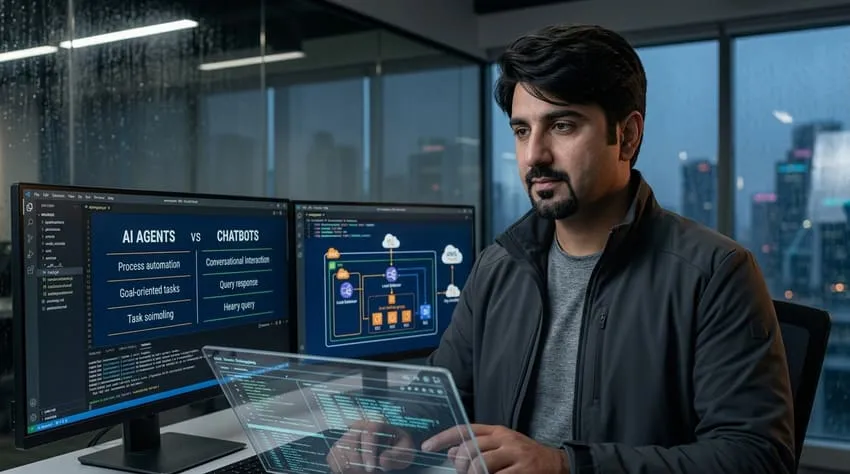
Autonomous AI agents, conversely, represent a paradigm shift. Unlike their rule-based predecessors, these agents are designed to understand intent, break down complex goals into actionable sub-tasks, execute these tasks using a suite of digital tools, and adapt their approach based on real-time feedback. This capability is fundamentally rooted in their ability to orchestrate multi-step business logic, transforming what was once a series of disjointed, human-mediated actions into a seamless, automated workflow. For instance, consider a customer support scenario that extends beyond a simple FAQ: a customer requests a refund for a damaged item, requiring verification of purchase, checking return policy, initiating a return label generation in an ERP, and finally, processing the refund through a payment gateway. A rule-based chatbot would likely falter after the first step, whereas a well-designed autonomous agent can autonomously navigate these disparate systems, making informed decisions at each juncture, and ultimately achieving the desired outcome without human intervention. This advanced capability necessitates a robust technical architecture, moving beyond simple API calls to sophisticated integration patterns and decision-making frameworks.
Production AI Architecture: Building for Reliability and Performance
Deploying autonomous AI agents in an enterprise setting demands an architectural rigor that far exceeds typical application development. The stakes are higher; these systems interact directly with critical business data and processes, requiring impeccable security, reliability, and performance. The core components of a production-grade AI agent architecture are designed to address these requirements comprehensively.
Secure Context Retrieval with Vector Databases
Effective autonomous agents require access to vast amounts of up-to-date, relevant information to inform their decisions and generate accurate responses. This necessitates sophisticated context retrieval mechanisms that go beyond keyword searches. Vector databases (vector DBs) are central to this. Instead of storing data as plain text, vector DBs embed information into high-dimensional numerical vectors, allowing for semantic similarity searches. When a user query or an agent’s internal thought process requires information, the query is also vectorized, and the vector database efficiently retrieves semantically similar chunks of information from the enterprise knowledge base. This RAG (Retrieval Augmented Generation) pipeline ensures that the Large Language Model (LLM) powering the agent operates with grounded, factual information, significantly mitigating hallucination risks. Critical enterprise data, ranging from internal policies and product specifications to historical customer interactions, can be securely indexed and retrieved. Secure access controls and data encryption are paramount at this layer, ensuring that sensitive information is only accessible to authorized components of the AI system.
Advanced Function Calling and Tool Execution
The “autonomy” of an AI agent stems directly from its ability to use tools – essentially, external functions or APIs – to interact with the digital world. This is where function calling, also known as tool use, becomes crucial. The LLM, based on its understanding of the user’s goal and available context, determines which tools are necessary to achieve that goal. This could involve calling an API to update a CRM record, fetching data from an ERP system, sending an email via an external service, or even interacting with an internal database. The architecture must include a robust tool registry and an execution layer that can dynamically invoke these functions, handle their input and output, and manage potential errors. This orchestration of tool use allows agents to perform concrete actions, moving beyond mere conversational replies. For complex tasks, this often involves chaining multiple function calls in a logical sequence, requiring the agent to maintain state and context across these operations.
Resilient Fallback Routines and Human-in-the-Loop Mechanisms
No AI system is infallible, and autonomous agents, despite their sophistication, will encounter scenarios they cannot resolve or where human judgment is explicitly required. Robust fallback routines are therefore non-negotiable in a production environment. These routines should intelligently detect when an agent is struggling (e.g., prolonged uncertainty, repeated errors, inability to find a suitable tool or answer) and gracefully escalate the situation. This often involves transferring the interaction to a human agent, providing the human with the full context of the AI’s attempt, or triggering predefined emergency protocols. Human-in-the-loop (HITL) mechanisms are a critical extension of this, allowing human oversight and intervention at key decision points or for critical transactions. This might involve an agent proposing an action and awaiting human approval before execution or routing specific types of queries directly to human experts. The goal is to maximize automation without sacrificing control, safety, or customer satisfaction.
Ensuring Low-Latency Responses for Real-time Interaction
Enterprise applications, particularly those involving customer interactions or critical operational processes, demand low-latency responses. An AI agent that takes several seconds to process a query or execute a task will quickly undermine user trust and operational efficiency. Achieving low latency in an architecture that involves multiple components – LLMs, vector databases, tool APIs, and orchestration logic – requires careful engineering. This includes optimizing data retrieval from vector databases (e.g., using efficient indexing strategies), minimizing the number of LLM calls, selecting performant LLMs, employing efficient API gateway patterns, and potentially using caching mechanisms for frequently accessed data or intermediate results. Edge deployments or specialized hardware for LLM inference can also contribute to reducing latency, ensuring that the autonomous agent feels responsive and integrated into existing workflows.
In-House Integration Friction: Navigating the Complexities
Developing and deploying production-grade AI agents in-house presents a unique set of challenges that extend beyond mere technical implementation. CTOs and product heads must confront issues that directly impact operational costs, system reliability, and user experience.
Hallucination Mitigation Strategies
Hallucination, where an LLM generates factually incorrect or nonsensical information, is a persistent and significant challenge. In a business context, hallucinations can lead to severe consequences, from misinforming customers to incorrect data entry in critical systems. Mitigating this requires a multi-pronged strategy. Beyond the foundational RAG architecture mentioned earlier, techniques like prompt engineering (crafting precise instructions for the LLM), output validation (checking the LLM’s response against known facts or rules before acting), and confidence scoring (having the LLM assess its own certainty) are essential. Furthermore, establishing strict guardrails and content filters can prevent the agent from straying into prohibited topics or generating inappropriate responses. These mitigation strategies are not one-time fixes but require continuous monitoring and refinement as model capabilities and business requirements evolve.
Managing Token Costs and Optimizing LLM Usage
The operational cost of LLM inference, particularly for large-scale deployments, can quickly become substantial, primarily driven by “token costs.” Tokens are the fundamental units of text that LLMs process, and both input (prompts, context) and output (responses) consume them. Unoptimized usage can lead to exorbitant cloud bills. Addressing this requires strategic approaches such as:
- Context Window Management: Only feeding the LLM the absolutely necessary context to answer a query or execute a task, avoiding verbose or redundant information.
- Response Length Optimization: Designing prompts to encourage concise and relevant responses rather than open-ended, lengthy outputs.
- Model Selection: Utilizing smaller, more specialized LLMs for specific tasks where a general-purpose, larger model might be overkill and more expensive.
- Caching and Pre-computation: Caching common responses or pre-computing frequently used data to reduce redundant LLM calls.
- Batching Requests: Where feasible, grouping multiple LLM requests to take advantage of economies of scale offered by API providers.
- Fine-tuning (where appropriate): For highly specific tasks, a fine-tuned smaller model can often outperform and be more cost-effective than a large general model.
Navigating API Rate Limits and Scalability Challenges
Enterprise systems often have strict API rate limits to prevent abuse and ensure stability. When an autonomous AI agent needs to interact with numerous internal and external services (CRM, ERP, payment gateways, etc.), these rate limits can quickly become a bottleneck, leading to errors and degraded performance. Designing for scalability involves:
- Asynchronous Processing: Implementing message queues and asynchronous processing patterns to decouple the agent’s logic from immediate API responses, allowing for graceful handling of rate limits and retries.
- Distributed Systems: Architecting the agent and its tool execution layer as a distributed system, capable of scaling out horizontally to handle increased load.
- Intelligent Backoff and Retry Mechanisms: Implementing robust error handling with exponential backoff and jitter for API calls to avoid overwhelming external systems and to recover gracefully from temporary rate limit breaches.
- API Gateway Management: Utilizing API gateways to centralize rate limiting, authentication, and traffic management, providing a unified and controlled interface for the agent to interact with various services.
- Resource Provisioning: Proactively monitoring and scaling the underlying compute resources for LLM inference, vector database queries, and tool execution to match demand.
Successfully navigating these in-house integration frictions demands not only deep technical expertise but also a strategic understanding of organizational priorities, risk tolerance, and long-term vision. The complexity often necessitates specialized knowledge in cloud architecture, AI/ML engineering, and enterprise systems integration.
Discover the future of customer service with our innovative AI Chatbots & AI Agents. These intelligent systems are designed to enhance user interaction and streamline processes. Explore how AI Chatbots & AI Agents can transform your business operations today.
Seamless Pivot & Elevating Enterprise AI Capabilities
The journey from conceptualizing AI-driven automation to deploying resilient, production-grade autonomous AI agents is fraught with intricate challenges. It requires a blend of advanced AI/ML expertise, robust software engineering practices, and a profound understanding of enterprise IT landscapes. Many organizations find that while they possess domain knowledge, the specialized skill set required to build and integrate these complex systems efficiently and securely is often external to their core competencies. This is particularly true when considering the nuances of RAG pipeline optimization, multi-agent orchestration, sophisticated LLM API routing, and deep CRM/ERP integrations that define true enterprise-grade AI.
For CTOs, product heads, and ops leaders seeking to truly revolutionize their operations with intelligent automation, relying on proven expertise can significantly accelerate time-to-value and mitigate project risk. igoher.com specializes in delivering such advanced capabilities, translating strategic vision into tangible, high-performing AI systems. Our approach focuses on architecting secure, scalable, and cost-effective solutions that seamlessly integrate with existing enterprise ecosystems. We navigate the complexities of secure context retrieval, implement resilient function calling with comprehensive fallback routines, and optimize for low-latency responses, ensuring your AI agents perform optimally under demanding enterprise conditions.
Our custom AI agent development services directly address the in-house integration friction points, from comprehensive hallucination mitigation strategies to intelligent token cost management and sophisticated API rate limit handling. We understand that every enterprise has unique operational workflows and data sensitivities. Therefore, our solutions are not off-the-shelf products but meticulously engineered systems tailored to your specific business requirements, ensuring maximum ROI and operational efficiency. By partnering with igoher.com, you gain access to a team that is adept at transforming complex AI theories into practical, production-ready applications that drive real business value.
The future of enterprise automation is autonomous, proactive, and deeply integrated. It’s about empowering your digital workforce with the intelligence to execute multi-step business logic, make informed decisions, and interact seamlessly across your entire digital footprint. This transition demands a level of sophistication and reliability that extends far beyond simple chatbots. To explore how production-grade AI agents can redefine your operational efficiency and customer experience, we invite you to schedule a discovery call with our solutions architects. Let’s discuss your specific challenges and how our expertise can accelerate your journey towards truly intelligent automation.
Frequently Asked Questions
What is the difference between an AI agent, a chatbot, and an assistant?
An AI agent is a program that can perform tasks autonomously, a chatbot is a computer program designed to simulate conversation with human users, and an assistant is a software program that assists users with various tasks.
How do AI agents, chatbots, and assistants use artificial intelligence?
AI agents, chatbots, and assistants use artificial intelligence algorithms to understand and respond to user input, learn from interactions, and improve their performance over time.
What are some common applications of AI agents, chatbots, and assistants?
AI agents are commonly used in automation, chatbots are used for customer service and information retrieval, and assistants are used for tasks like scheduling, reminders, and information search.
Can AI agents, chatbots, and assistants work together in a system?
Yes, AI agents, chatbots, and assistants can be integrated into a single system to provide a comprehensive solution for various tasks, combining their strengths to enhance user experience.
How do AI agents, chatbots, and assistants differ in terms of complexity and capabilities?
AI agents are typically more complex and capable of performing a wider range of tasks autonomously, while chatbots and assistants are more specialized in their functions and may require more user input or guidance.
Ready to Scale Your Technical Operations?
Need autonomous AI that actually executes tasks? Discover how our AI Agents can transform your operational efficiency.